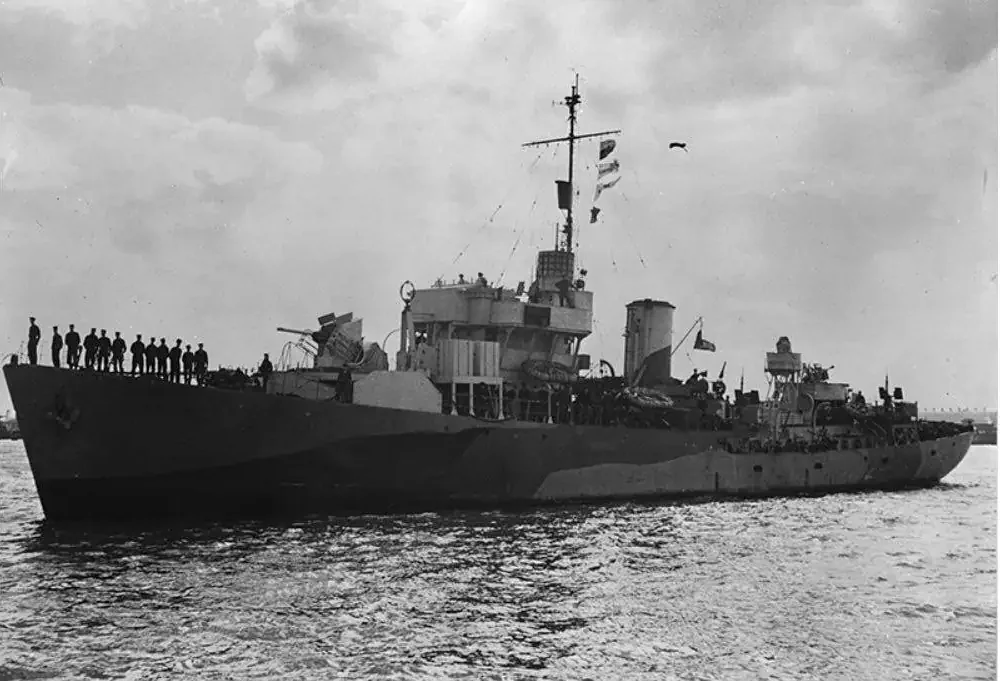
In a significant move to safeguard underwater war graves, the United Kingdom’s Ministry of Defence (MoD) has designated the wrecks of two Royal Canadian Navy (RCN) Flower-class corvettes, HMCS Trentonian and HMCS Regina, as “Controlled Sites” under the Protection of Military Remains Act 1986 (PMRA). The new statutory instrument, which came into force on 30 March 2026, also adds the experimental destroyer HMS Cobra to the list of controlled sites and extends protections to more than two dozen additional military wrecks around the UK.
Under the PMRA, military vessel remains on the seabed are classified in two ways: as “Protected Places,” where divers may observe but not touch or disturb the wreck, or as stricter “Controlled Sites,” where any diving or interference requires explicit written permission from the MoD. Controlled Sites carry the highest level of restriction; unauthorised access can lead to investigation by the Ministry of Defence Police and potential prosecution. This latest order brings the total number of controlled sites to 16 and protected places to 113, reflecting growing efforts to curb illegal scavenging of wartime wrecks.
Both Trentonian and Regina were lost during the Second World War while operating in UK coastal waters as part of Allied convoy escorts during the Battle of the Atlantic and subsequent operations.
HMCS Trentonian (K368), named after Trenton, Ontario, was a late-war “Increased Endurance” Flower-class corvette commissioned in December 1943. On 22 February 1945, while escorting Channel convoy BTC-76, she was torpedoed by German submarine U-1004 approximately 12 miles east of Falmouth, Cornwall. The torpedo struck starboard aft; the ship sank rapidly within minutes. One officer and five ratings perished, with survivors (including 11 wounded) rescued by British Fairmile motor launches. The wreck now lies in about 65 metres of water in the English Channel.
HMCS Regina (K234), another Flower-class corvette, met a similarly swift end on 8 August 1944. While rescuing survivors from the torpedoed American Liberty ship SS Ezra Weston some 8 nautical miles (15 km) north of Trevose Head, Cornwall, she was struck by a torpedo from U-667. The corvette sank in just 28 seconds, with 30 of her crew of approximately 85–96 lost—many from the engine and boiler rooms. The wreck, lying in roughly 60 metres of water near that of the Ezra Weston, has long been a site of interest to divers and maritime archaeologists.
These wrecks are not only historic relics but also the final resting places of Canadian sailors who served alongside British forces far from home. Their protection underscores the UK’s commitment to honouring Allied sacrifices in British territorial waters, regardless of nationality.
The designation of Trentonian as a controlled site appears directly linked to a high-profile 2025 incident. UK wreck diver Dom Robinson recovered the ship’s bell from the English Channel wreck in April 2025. He declared it to the Receiver of Wreck in full compliance with existing law, waived his salvage rights, and personally handed it over to Canadian naval representatives for restoration and eventual display in Canada. While the recovery was legal at the time and widely praised for returning a piece of Canadian heritage, it reportedly prompted concerns from Canadian authorities and highlighted vulnerabilities in wreck protection.
Shipwreck archaeologist Michael Williams noted that the new controlled-site status “has to be a direct result of the raising of the bell” and sends a clear signal to the diving community: removing material from military sites may result in the loss of public access.
The 2026 order also extends exclusion zones around two iconic controlled sites—HMS Royal Oak and HMS Vanguard at Scapa Flow—and adds numerous other wrecks as protected places, including recently discovered First World War losses such as HMS Jason, Hawke, and Nottingham, as well as the French minesweeper Emile Deschamps and the US Coast Guard cutter Tampa (whose wreck remains undiscovered).
The MoD emphasises that the vast majority of divers act responsibly. However, over the past 25 years, thousands of artefacts have been legally or illegally recovered from protected wrecks. The new measures aim to deter interference while the government pushes for even stronger automatic protections. A clause in the upcoming Armed Forces Bill would designate all qualifying military wrecks in UK waters as Protected Places by default, regardless of age.
For recreational divers, the practical impact is clear: diving Trentonian, Regina, or Cobra now requires prior MoD approval. The wrecks remain accessible to responsible exploration under licence, but unauthorised salvage or disturbance is strictly prohibited.
The imposition of these Controlled Site Orders ensures that the wrecks of HMCS Trentonian and HMCS Regina—symbols of Canadian valour in the fight against fascism—will be preserved for future generations. They stand as solemn underwater memorials to the sailors who gave their lives in British waters, a tangible reminder that the bonds forged in wartime continue to shape heritage policy today.
As maritime archaeologist and naval historians have observed, such protections not only guard physical remains but also honour the memory of those who rest there. In an era when underwater cultural heritage faces increasing pressures, the UK’s actions set a precedent for international cooperation in safeguarding shared wartime history.
Related posts:
HMCS Max Bernays: Navigating from Arctic Ice to Indo-Pacific Waves
The Truth about Canadian and American Icebreaking Capability
South Korean Submarine Arrives in Esquimalt as Hanwha Showcases Bid for Canada’s New Sub Fleet