

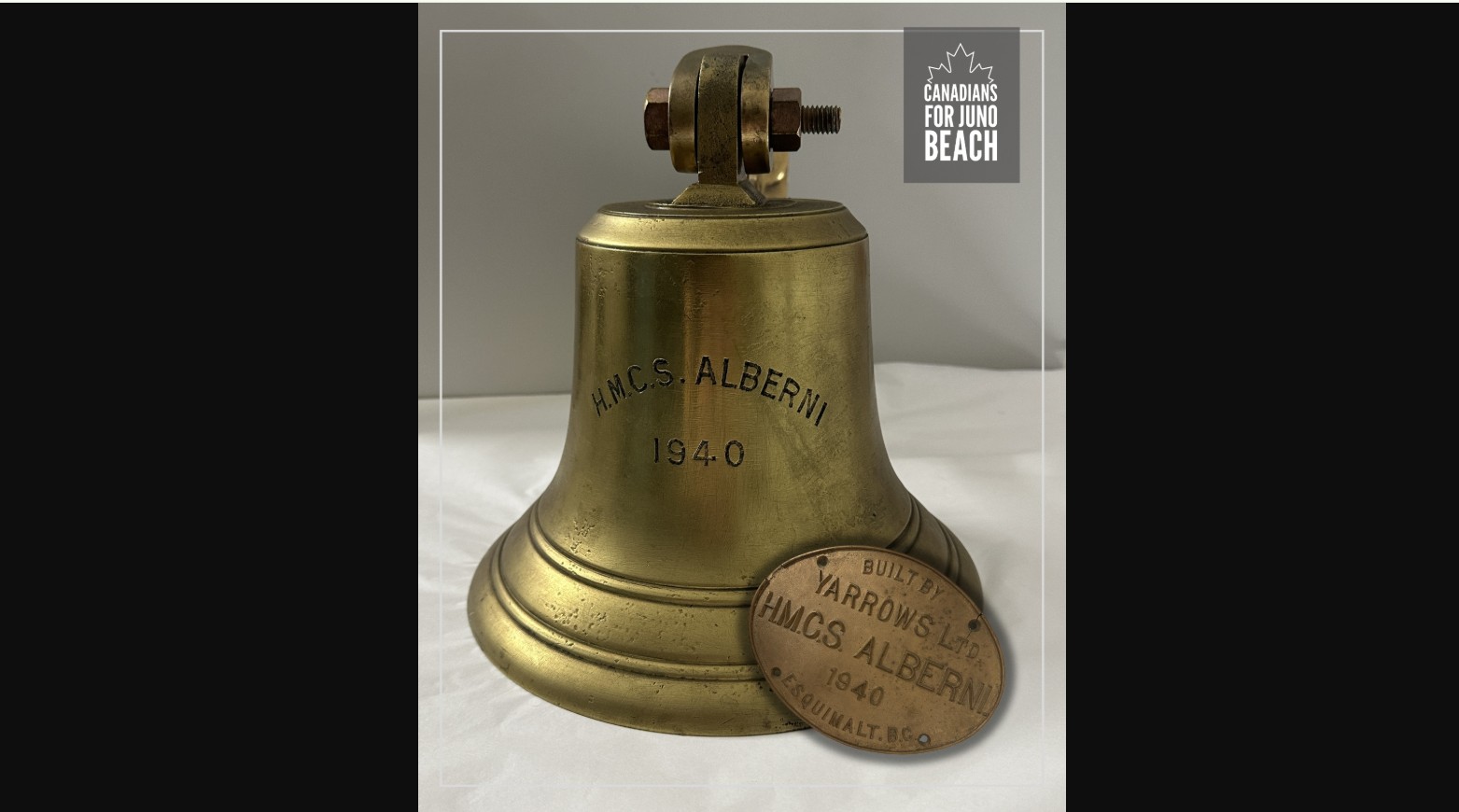
COURSEULLES-SUR-MER, France — On April 30, 2026, the Juno Beach Centre Association (JBCA) announced the acquisition of two powerful artifacts from the Royal Canadian Navy’s HMCS Alberni: the ship’s bell and its original 1940 builders’ plate. Recovered from a private collection in the United Kingdom, these tangible links to one of Canada’s most storied corvettes now reside at Canada’s official Second World War museum and memorial in Normandy, where they will be conserved, studied, and displayed for visitors from around the world.
A Corvette Built for the Battle of the Atlantic
HMCS Alberni (K103) was a Flower-class corvette, one of the “cheap and nasties” — as Winston Churchill famously called them — that formed the backbone of Canada’s rapidly expanding navy. Ordered in February 1940 and laid down at Yarrows Ltd. in Esquimalt, British Columbia, the ship was launched in August 1940 and commissioned on February 4, 1941.
Lightly armed and notoriously uncomfortable, these small escort vessels nevertheless proved vital. Alberni spent years protecting trans-Atlantic convoys during the Battle of the Atlantic, the longest continuous campaign of the war. She later supported Operation Torch in the Mediterranean, rescued survivors from torpedoed merchant ships, and took part in the invasion of Normandy. On D-Day, June 6, 1944, she escorted support ships off Juno Beach. Just weeks later, on July 26, 1944, her crew even shot down a German Ju 88 aircraft.
Tragedy struck on the evening of August 21, 1944. While on anti-submarine patrol in the English Channel east of the D-Day landing beaches, Alberni was torpedoed by the German U-boat U-480 — a submarine equipped with experimental anechoic (sound-absorbing) tiles that made it nearly invisible to Allied sonar. The torpedo struck the port side aft of the engine room. The corvette sank in less than a minute. Of her crew, 59 sailors were lost; 30–31 were rescued by Royal Navy motor torpedo boats.
The wreck of HMCS Alberni still lies in UK waters as a war grave. For decades, these sites received little legal protection, allowing sport divers to recover artifacts. The bell and builders’ plate were removed from the wreck by a diver and later passed into private hands in Britain before the Juno Beach Centre stepped in last summer (2025) to purchase them from the diver’s family.
A Dignified Home at Juno Beach
The Juno Beach Centre, located directly on the sands where Canadian troops landed on D-Day, already tells the story of Canada’s contribution to the liberation of Europe. Bringing the Alberni artifacts into its collection strengthens that narrative by highlighting the often-overlooked naval dimension of the Normandy campaign and the Battle of the Atlantic.
“These artifacts are not simply historical objects — they are powerful, tangible connections to the sailors who served and sacrificed aboard HMCS Alberni,” said Alexander Fitzgerald-Black, Executive Director of the Juno Beach Centre Association. “By bringing them into the care of the Juno Beach Centre, we are ensuring that their story is preserved with dignity and shared with future generations.”
Lewis Bartholomew, Executive Director of the HMCS Alberni Memorial and Museum in Courtenay, British Columbia, welcomed the move: “The Juno Beach Centre’s acquisition of the Ship’s Bell has greatly added to preserving the history of HMCS Alberni and strengthens the honour which her crew so rightly deserve. We look forward to working with the Juno Beach Centre to tell the story of the brave and heroic men and women who liberated Europe.”
The Centre plans to integrate the bell and builders’ plate into future exhibitions and educational programs. A digital exhibition featuring 3D scans will make the artifacts accessible to audiences worldwide. The JBCA is currently seeking donations to support conservation and display efforts.
Broader Efforts to Protect Naval Heritage
The acquisition comes amid growing international recognition of Canadian naval war graves. In March 2026, the United Kingdom extended protections to additional Royal Canadian Navy wrecks under the Protection of Military Remains Act. While Alberni was not initially included, ongoing legislative changes aim to safeguard all such sites, treating them with the same respect afforded to land-based graves.
As Battle of the Atlantic Sunday approaches on May 3, 2026 — marking 81 years since the campaign’s end — these artifacts serve as a timely reminder of Canada’s enormous contribution to victory at sea and the enduring sacrifice of 2,000 Canadian sailors who never came home.
At the Juno Beach Centre, the bell that once rang across the Atlantic and the plate that identified the ship’s proud builders now stand as silent witnesses to courage, duty, and remembrance — ensuring that the men of HMCS Alberni are honoured not only in memory, but in the very place where Canadian forces helped turn the tide of history.
Visitors to Normandy this summer and beyond will have the chance to see these artifacts firsthand, connecting personally with a chapter of Canadian naval history that deserves its place alongside the Army’s celebrated achievements on Juno Beach.
For more information:
https://campaign.junobeach.org/post/alberni-campaign-launch
