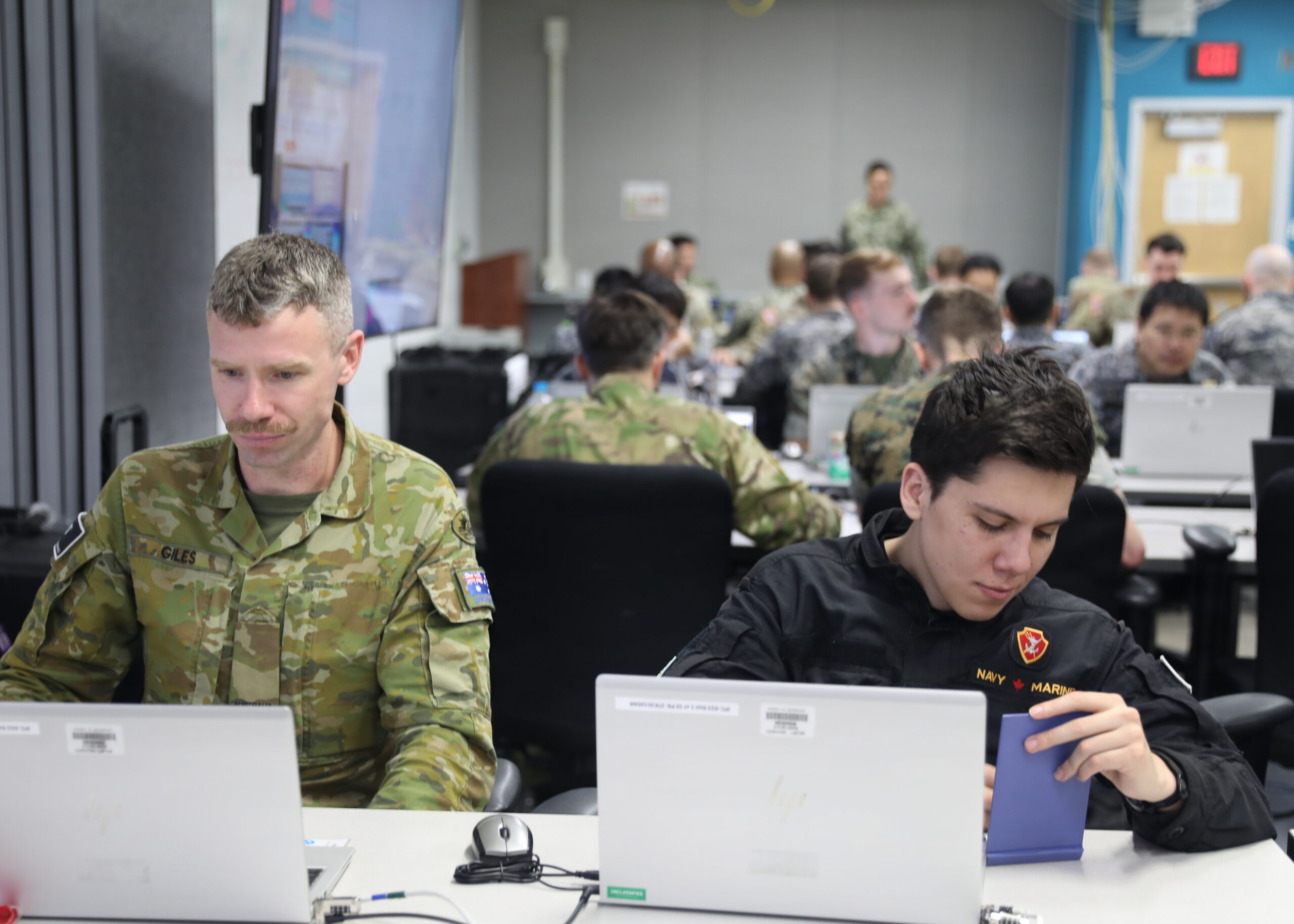
TOKYO, Japan – Security forces from seven allied and partner nations are currently gathered in Japan for Keen Sword 27, a biennial field training exercise between the Japan Self-Defense Force, the U.S. military, and their partners. More than 56,000 personnel are engaged in a wide range of training activities on land, at sea, and in the air, while an elite contingent are engaged in a multilateral cyber security exercise.
From Oct. 22 to 28, approximately 80 cyber security experts from Japan, the United States, Australia, Canada, and New Zealand are engaged in the Keen Sword 27 cyber exercise, which will test their combined capability to defend critical infrastructure against malicious cyber intrusions.
“We’re working with partners from all over the world, and what’s really fascinating is how much we have in common,” said U.S. Air Force Maj. Paul Lucero, team lead for the cyber exercise. “We may speak different languages, but we all speak cyber. Like aviation, cyber has a technical terminology that transcends linguistic and cultural barriers. We deliberately put multinational teams together to ensure that they share techniques and procedures. The main objective here is to learn from each other.”
“It is very useful for us to see partner countries’ methodologies, frameworks, and tactics for countering cyber threats to better enable us to work together in defense of critical infrastructure,” said Capt. Tomoya Kanno, a cyber unit staffer with the Japan Air Self-Defense Force.
Most cyber exercise participants are split into six teams, each tasked with defending a specific target, such as a hospital, airport, seaport, or fuel depot, from cyber attacks. An exercise “red cell” works to infiltrate those networks, while the “white cell” serves as the control team, overseeing the exercise and ensuring that the exercise runs smoothly. The six defending teams are engaged in what they call “the hunt,” an intelligence-led activity that begins with a tip-off that there is malicious activity on their network. Then, cyber warriors go to work looking for the source of the intrusion and countering it.
“Our teams are constantly conducting reconnaissance and defending against simulated intrusions, in many cases by adapting techniques from the international partners sitting next to them,” Maj. Lucero said. “Everyone participating in this exercise will go home with a new set of best practices to employ in their real world assignments.”
“We experienced some initial administrative and technical challenges on day one,” said Royal Australian Air Force Flt. Lt. Caro-Lynn Wong, cyber detachment commander, “but that’s to be expected any time you have so many participants from different countries coming together. We quickly learned and adopted best practices to make the most of our systems, and just two days into the exercise, we are now running at full speed.”
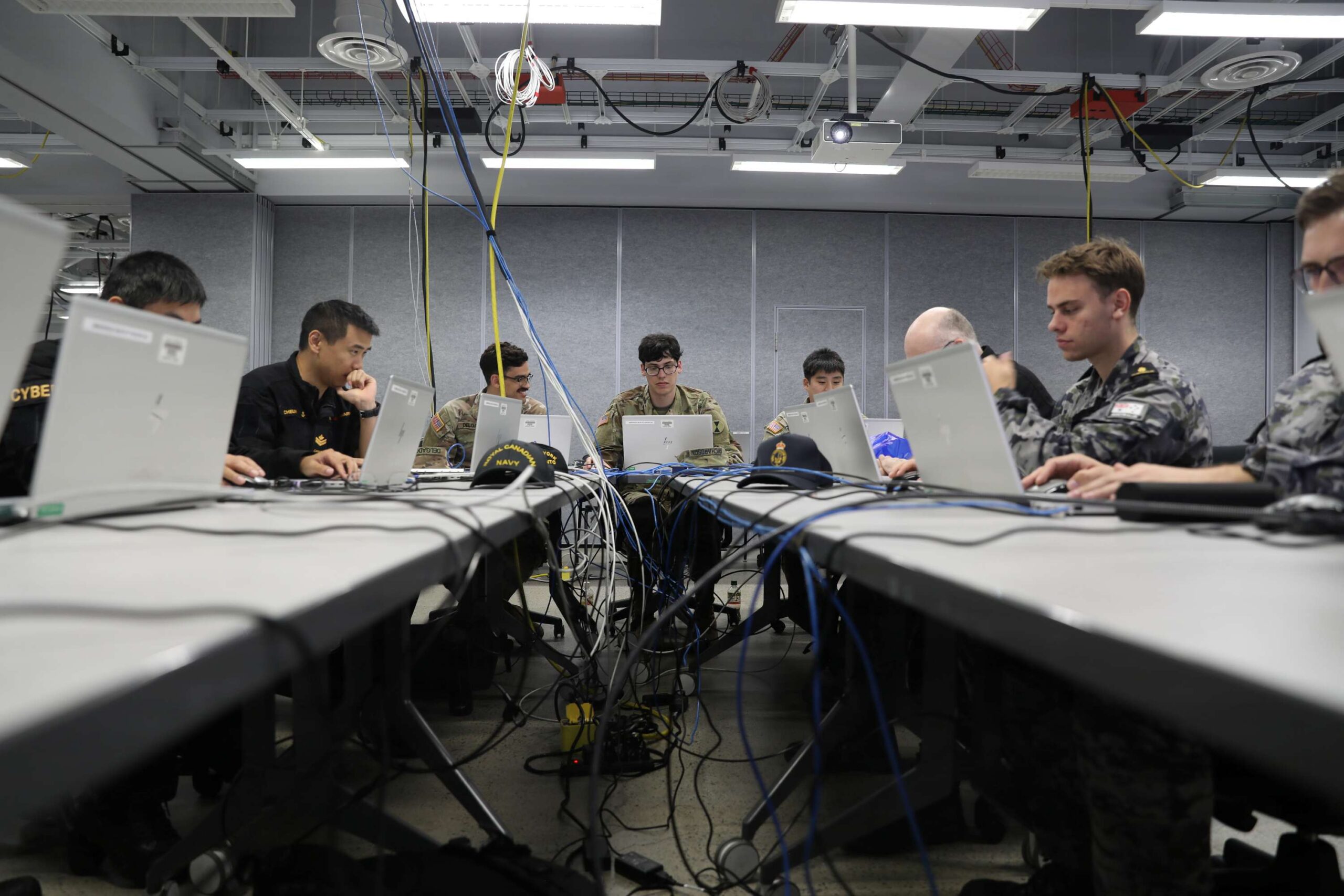
“The most useful part of this exercise is being able to integrate skills learned in prior exercises and testing our techniques with and against our partners to see how we measure up,” said Royal New Zealand Air Force Flt. Lt. Ben Riedstra, Air Force cyber lead. “This exercise provides a realistic but safe environment to test out our tactics against a simulated threat and see how our technical skills pair with those of our allies. The biggest challenge was showing up and not knowing your team or the mission, but by leaning on our combined technical knowledge and skills, we hit the ground running, and now we’re gaining some very useful insights.”
“I come from a blue team (defender) background, so it’s a very different and refreshing experience to be on the offensive side instead,” said Royal Canadian Navy Sailor 1st Class Andrew Pang, a red cell member for the Canadian cyber team. “Traditionally, there was a heavy focus on the blue team’s working to implement and validate our processes. As the red team, we’re the ones helping build the scenario for the blue teams to practice on. One of the objectives here is to facilitate collaboration and learn how each other’s teams work, and I see our role as working to set the scenario’s pace to ensure the defenders are adequately challenged for the duration of the exercise.”
The cyber exercise is conducted on a closed network with real-time injects from the broader Keen Sword 27 field exercise. Meanwhile, the work of the cyber defenders in the room impacts those out in the field. “We have teams protecting the airport and a fuel depot from cyber attacks. If they fail at their tasks in here, then the teams out in the field can’t use those assets in the exercise. Our mission in cyberspace directly supports troops on the ground,” said Flt. Lt. Wong.
Keen Sword is a routine, biennial, bilateral field training exercise with multinational participation, designed to increase readiness and interoperability between the U.S. military and Japan Self-Defense Forces while strengthening the ironclad U.S.-Japan Alliance.
Story by Lt. Dennis Petersen
Related posts:
Canada's Pacific Fleet Commander Calls for Urgent Submarine Acquisition to Bolster Defence Capabilit...
HMCS Charlottetown departs on Operation HORIZON and NEON

HMCS Charlottetown to participate in Exercise VALIANT SHIELD 2026