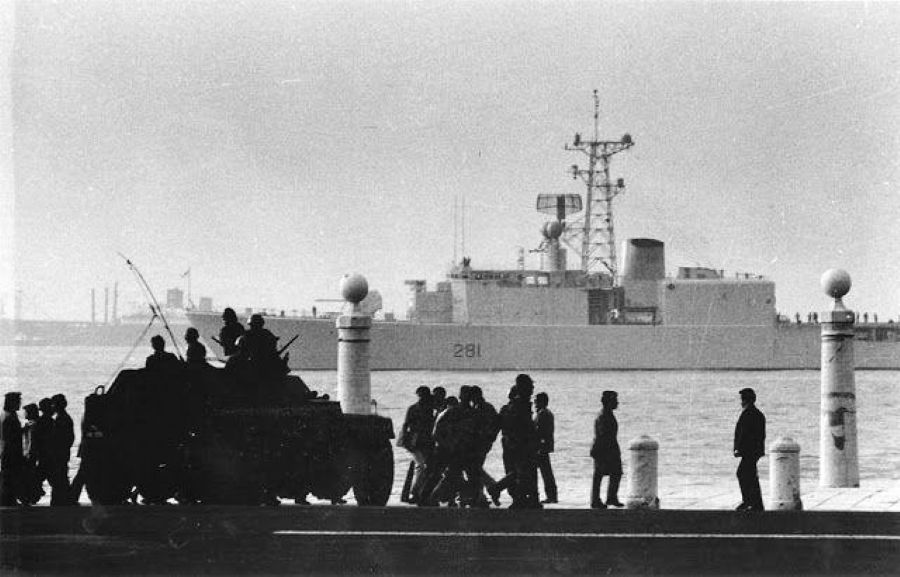
On 25 April 1974, several ships of the Royal Canadian Navy (referred to as “Maritime Command” at the time of the incident) were in the Port of Lisbon as Portugal’s Carnation Revolution overthrew the Estado Novo dictatorship.
The presence was coincidental, tied to a scheduled NATO exercise rather than any planned involvement in Portuguese politics. Most of the Canadian vessels departed that morning as planned; one destroyer remained and briefly found itself in a tense standoff with a Portuguese warship.
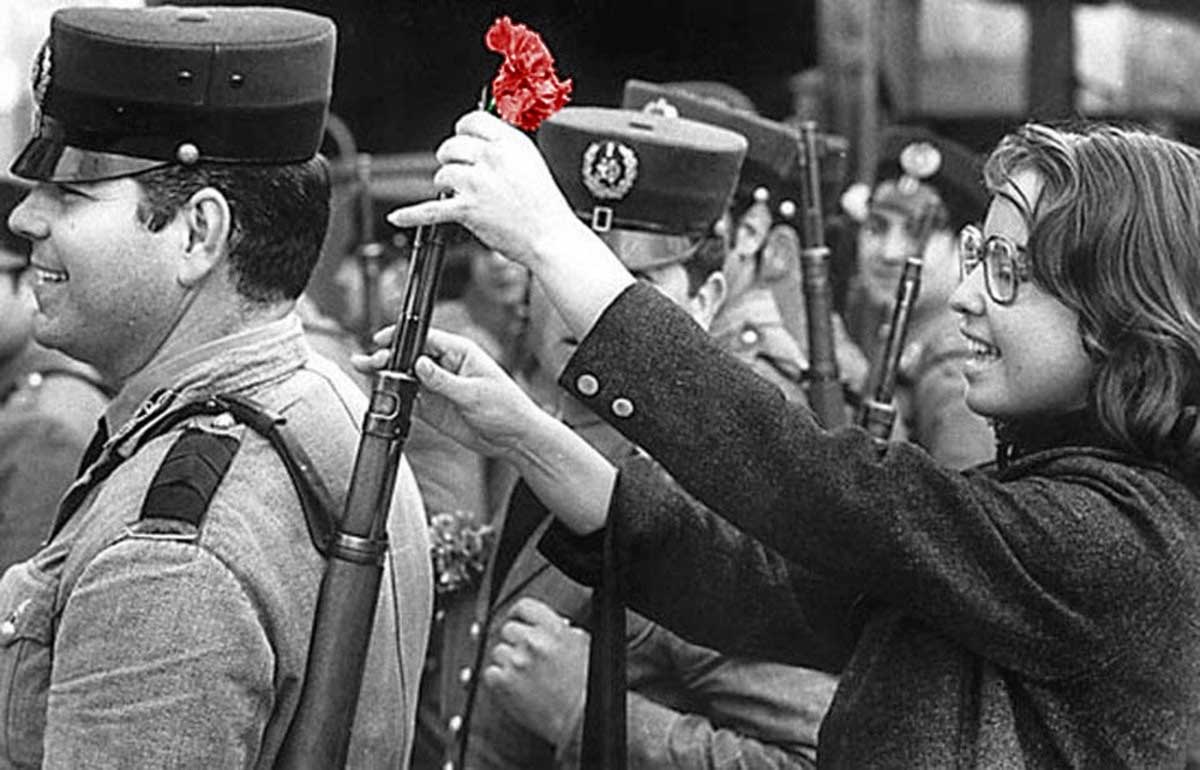
The revolution itself was a nearly bloodless military coup led by mid-ranking officers of the Armed Forces Movement (MFA). After decades of authoritarian rule under António de Oliveira Salazar and his successor Marcello Caetano, and amid exhausting colonial wars in Africa, the military seized key points in Lisbon. Civilians placed red carnations in soldiers’ rifle barrels, giving the event its name. The government fell within a day.
NATO Exercise Dawn Patrol
NATO’s Exercise Dawn Patrol was set to begin on the morning of 25 April. A Canadian task group had sailed from Halifax on 16 April: the replenishment ship HMCS Preserver, the Iroquois-class destroyers HMCS Huron and HMCS Iroquois, the St. Laurent-class helicopter destroyer HMCS Assiniboine, and the Annapolis-class destroyer HMCS Annapolis. They rendezvoused in Lisbon on 23 April with other NATO ships for briefings and a short port visit. HMCS Yukon, then serving as flagship of the Standing Naval Force Atlantic (STANAVFORLANT), also arrived and transferred flagship duties to Annapolis.
The move of NATO ships from alongside berths to anchorages in the Tagus estuary was a pre-planned part of the exercise schedule, not a response to events ashore. Most of the fleet, including the bulk of the Canadian group, sailed around 11:00 a.m. to begin the exercise, which later continued into the Mediterranean.
HMCS Assiniboine’s Unplanned Stay
HMCS Assiniboine was the exception. On 22 April, while en route, she encountered the Grenadian merchant ship MV Trade Mariner, which had been adrift without power for eight days. After unsuccessful repair attempts, Assiniboine took the vessel in tow and arrived in Lisbon on 24 April. The delay earned her permission to remain an extra day, until 26 April.
At about 7:00 a.m. on 25 April she shifted to an anchorage so the rest of the NATO force could depart. Two sailors had been left ashore to move a rental vehicle. The coup had begun around 3:00 a.m.; by morning the city was in the hands of MFA units, though the situation was still fluid.
Shortly after 9:00 a.m., the Portuguese frigate NRP Almirante Gago Coutinho appeared, guns trained, and circled the harbour and Assiniboine. The Canadian ship raised its state of watertight readiness but took no provocative action. Tension eased later that morning when the Portuguese frigate elevated its guns skyward, signalling neutrality after its own officers reportedly declined orders to fire on positions in the city.
Commanding Officer Commander Robin Corneil went ashore around 10:25 a.m. with a small party to consult the Canadian ambassador. Communications were limited; the ambassador initially offered little specific guidance. An American assistant naval attaché provided a clearer picture of events, which Corneil passed to the embassy. Two Assiniboine sailors already ashore witnessed commotion and heard gunfire near the PIDE (secret police) headquarters, the site of the revolution’s only significant bloodshed. Corneil returned to the ship around midday, collected the remaining crew, and Assiniboine weighed anchor shortly before 3:00 p.m., steaming slowly down the Tagus.
A Canadian Forces Argus maritime patrol aircraft detachment from 405 Squadron was also in the area, at Montijo airfield across the harbour, preparing for the same exercise. With the airport closed, they could neither depart nor participate.
Canadian authorities had considered the possibility of a non-combatant evacuation if the coup turned violent or prolonged. It did not. There was no direct threat to Canadians, and no evacuation was required. The entire Canadian naval presence lasted only that single day in operational terms.
The episode remains a minor footnote. The Carnation Revolution succeeded with remarkable speed and little violence, transforming Portugal into a democracy and ending its colonial wars. The Royal Canadian Navy ships were simply in the right harbour at the wrong (or, depending on perspective, the historically interesting) moment. Their presence illustrated both the routine nature of NATO port visits in the Cold War and how quickly local political events could overtake an exercise schedule.