

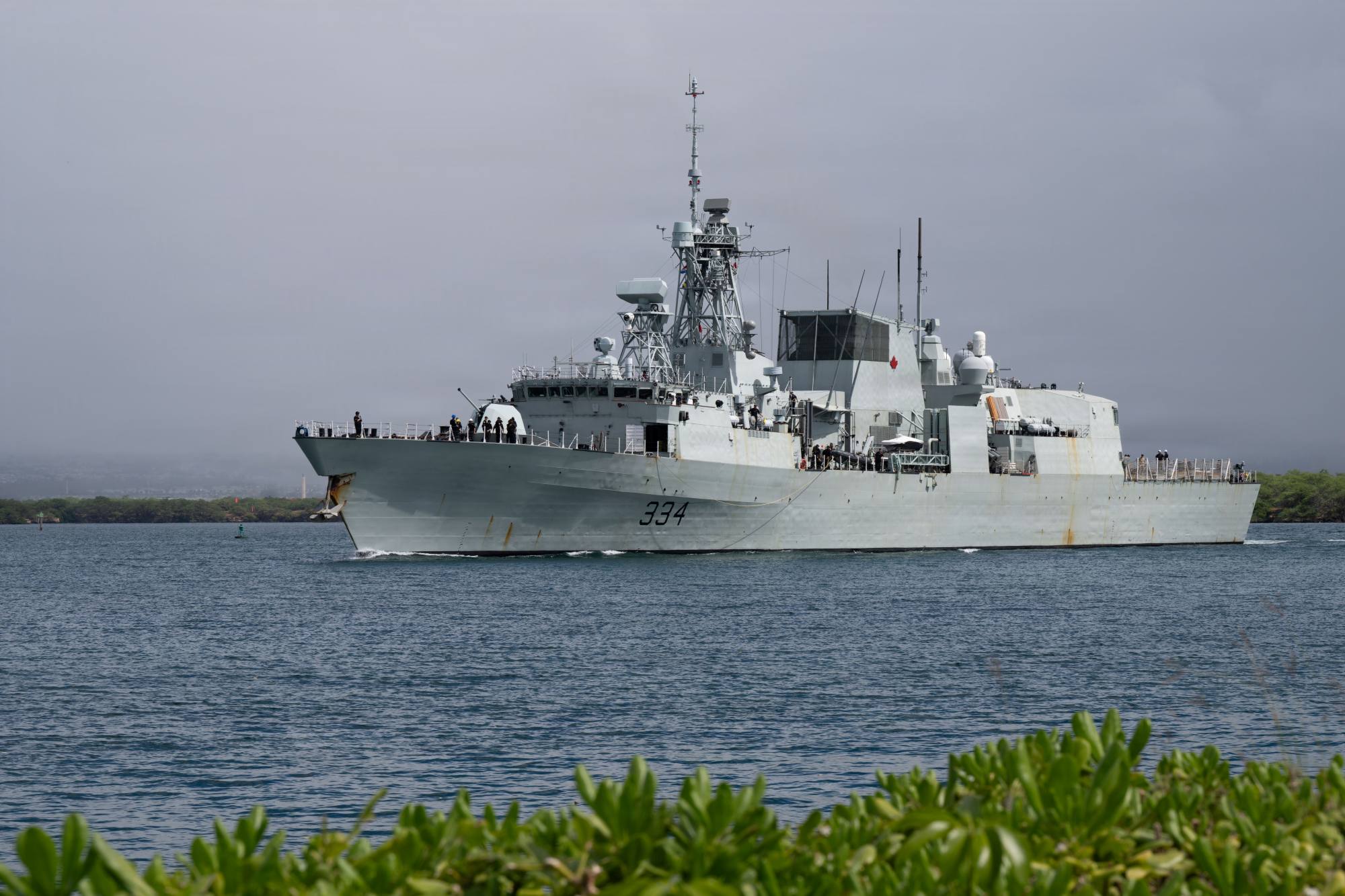
HMCS Regina aborted a planned Evolved Sea Sparrow Block II live-fire at Exercise RIMPAC 2026, off Hawaii, after drone target hardware failed, but the crew still extracted most of the training value from months of preparation.
The Halifax-class frigate had joined the 30th Rim of the Pacific exercise off Hawaii expecting to fire the navy’s most advanced air-defence missiles. The shot never happened as faults were found in two of the drone-like aerial targets at the U.S. missile range, and the test was cancelled at the last minute.
Commander Darren Sleen, the ship’s commanding officer, said a technical failure in the targets’ control system meant they could not fly the required profile. The fast-moving drones were supposed to follow a specific path so the missile could engage them. With that path unavailable, firing an expensive interceptor made no sense.
“There was a technical failure with two of the targets, so they did not actually fire the missile because it just did not make sense to expend those resources,” Sleen told CTV News.
The crew had spent about three months working through the requirements, tactics and procedures for the Evolved Sea Sparrow Missile (ESSM) Block II shot. The Block II variant uses its own active radar seeker rather than relying primarily on the launching ship’s radar, a significant upgrade over earlier Sea Sparrow missiles. Regina was one of the platforms expected to demonstrate the new capability during the multinational exercise.
Sleen described the outcome as a big disappointment for the team. They completed the planning, rehearsals and systems checks but missed “the thrilling conclusion to actually see the missile fly.” He added that the crew still received the bulk of the training value from the work-up.
The aborted missile test remained a footnote in an otherwise full operational schedule.
RIMPAC 2026 ran from 24 June to 31 July and involved roughly 30 nations, more than 30 surface ships, five submarines and about 30,000 personnel. Canada sent Regina, sister ship HMCS Ottawa, submarine HMCS Corner Brook, the replenishment vessel MV Asterix, a CP-140 Aurora, two CH-148 Cyclones and more than 800 personnel. Ottawa used the exercise to test an upgraded underwater warfare suite; Regina’s planned ESSM firing was the corresponding air-defence highlight.
HMCS Regina is Still Deployed
The cancellation did not alter the rest of Regina’s six-month Indo-Pacific deployment, which began in June from British Columbia. After RIMPAC the ship took part in Pacific Vanguard 2026 with the United States, Japan, Australia and South Korea.
Regina made courtesy calls to the Philippines and Cambodia, in a gesture to build better relations with the two countries. She also spent time exercising with the Philippine Armed Forces.
Regina is next slated for Exercise Keen Sword with U.S. and Japanese forces, followed by two weeks of maintenance in South Korea and patrols under Operation Neon, Canada’s contribution to enforcing United Nations sanctions on North Korea. The ship is due back in her home port of Esquimalt in December.
Commander Sleen also downplayed a North Korean warning issued after Pacific Vanguard, describing the drills as routine naval practice for worst-case scenarios rather than a campaign aimed at any specific country.
