
HMCS MICMAC (R10 / Postwar-214)

HMCS MICMAC
The History of HMCS MICMAC

HMCS Micmac was the only ship of that name in the Royal Canadian Navy. She was a Tribal-class destroyer named for the Mi'kmaq First Nations of Nova Scotia, following the practice of naming Canadian Tribal-class vessels after Indigenous peoples or language groups.
She was the first destroyer and, at the time, the largest warship built in Canada. Her keel was laid at Halifax Shipyards Ltd. in Halifax, Nova Scotia, on 20 May 1942. She was launched on 18 September 1943 and commissioned at Halifax on 12 September 1945 under Acting Lieutenant-Commander R. L. Hennessy, DSC, RCN. Completion came too late for service in the Second World War. She was the lead ship of four Tribals built in Canadian yards (followed by Nootka, Cayuga and Athabaskan) and one of eight Tribal-class destroyers to serve in the RCN.
Micmac spent her entire career as a training ship and never fired a shot in anger. She was often nicknamed "Old Dobbin" or described as the work-horse of the East Coast because many officers and ratings gained their first sea experience aboard her. Duties included workups, gunnery and anti-submarine training, plane-guard duties for the aircraft carrier HMCS Magnificent, Caribbean and European cruises, NATO exercises and showing the flag. Her motto was Melkedae (Fearless).
On 16 July 1947, during full-power trials in fog off Halifax, she collided with the freighter SS Yarmouth County. The impact destroyed her bow (including about 40 feet of the forward structure and the A gun mount), broke her keel and caused other severe damage. The collision resulted in five deaths, six missing and presumed dead, and 27 injured, one of the largest peacetime losses of life in Canadian naval history. The crew's efforts kept the ship afloat and it was brought into harbour. While under repair she received a partial conversion toward destroyer-escort configuration and returned to service early in 1950. Keel damage prevented any deployment to the Korean War. Full conversion to a destroyer escort was completed in 1952 and she was recommissioned on 14 August 1953. The conversion emphasized anti-submarine capability with Squid mortars and revised gun armament.
Specifications included a displacement of about 2,200 tons, dimensions of roughly 114.9 m by 11.4 m by 3.4 m, a top speed of about 36 knots and a crew of around 259. Original armament featured six 4.7-inch guns in three twin mounts, a twin 4-inch mount, lighter anti-aircraft guns, torpedo tubes and depth charges; the escort conversion replaced much of this with 4-inch and 3-inch guns, Bofors, torpedoes and Squid mortars.
After further years of training, exercises and overseas visits, increasing mechanical defects led to her being declared surplus in late 1963. She was paid off at Halifax on 31 March 1964 and broken up at Faslane, Scotland, in 1965.
HMCS MICMAC Statistical Data
- Pendant: R10 / Postwar-214
- Type: Destroyer
- Class: TRIBAL 1940s
- Displacement: 2,200 tonnes
- Length: 355.5 ft
- Width: 37.5 ft
- Draught: 11.2 ft
- Speed: 32 kts
- Compliment: 14 Officers and 245 Crew
- Arms: 6 - 4.7" (3XII), 2 - 4" (IxII), 4 - 2 pdrs (1xIV), 6 - 20mm, 4 - 21" TT (1xIV). Revised: 4 - 4" (2xII), 2 - 3" (1xII), 4 - 40mm, 4 - 21"TT (1XIV), 2 x Squid.
- Builder: Halifax Shipyards Ltd., Halifax, NS
- Keel Laid: 20-May-42
- Date Launched: 18-Sep-43
- Date Commissioned: 12-Sep-45
- Paid off: 31-Mar-64
Photos
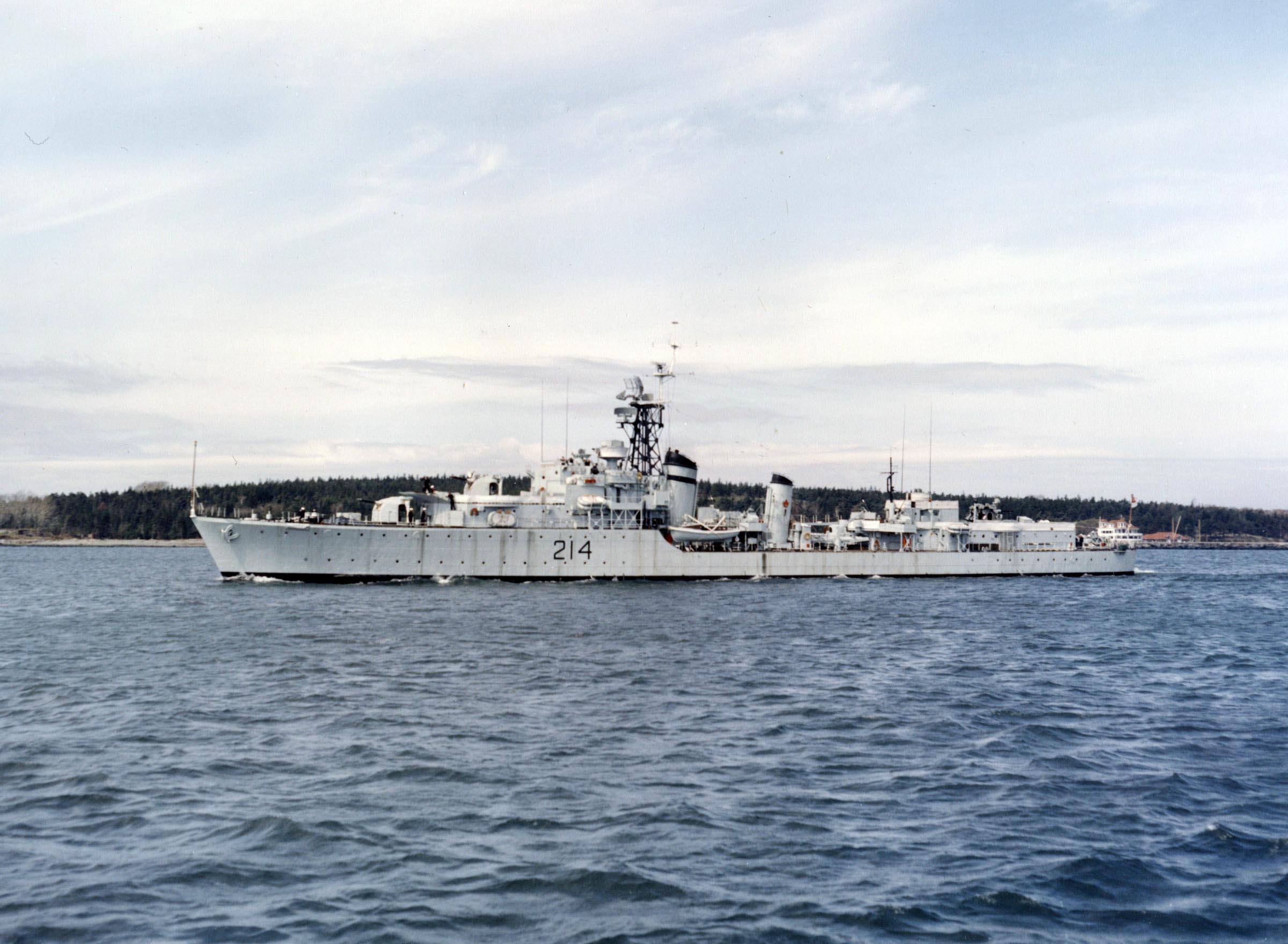
Post War HMCS MICMAC
Keywords: HMCS MICMAC, Royal Canadian Navy Ship, Destroyer, TRIBAL 1940s Class