

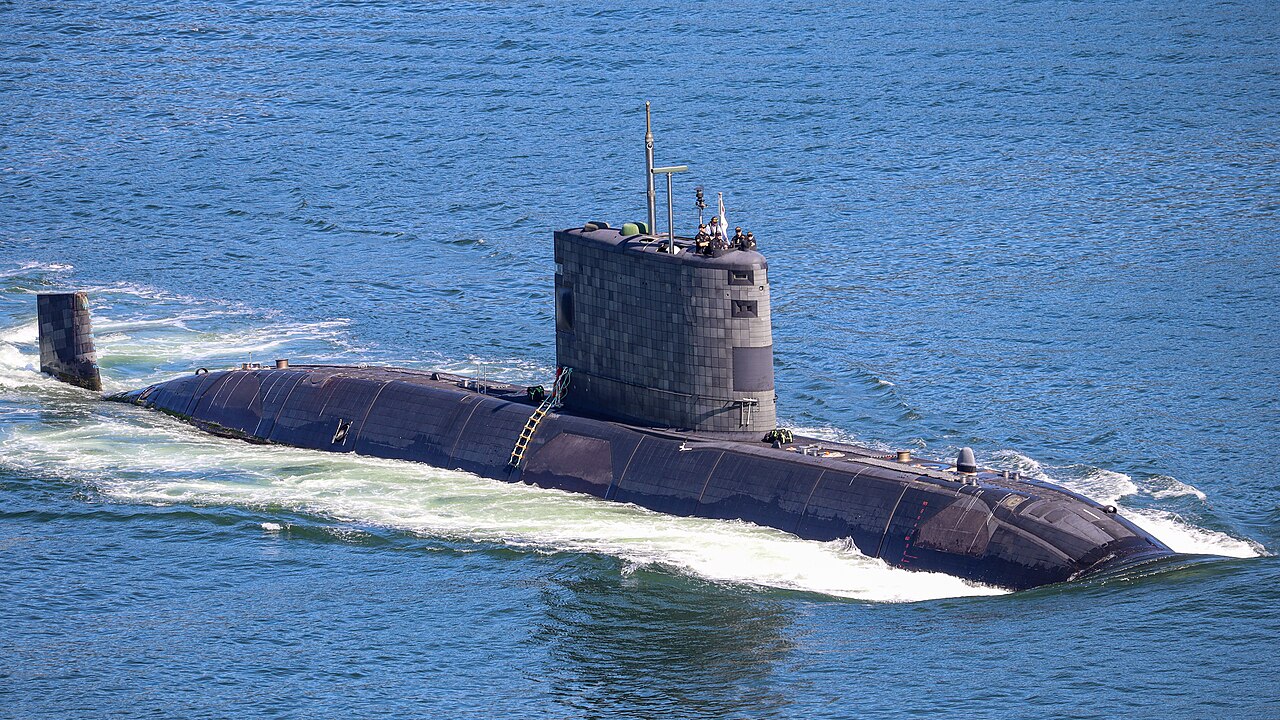
In a significant step to modernize its underwater fleet, the Royal Canadian Navy (RCN) will equip its four Victoria-class diesel-electric submarines with state-of-the-art digital optronic periscopes. On February 26, 2026, Canada’s Department of National Defence announced a CAD $118 million (excluding taxes) contract awarded to Safran Trusted 4D Canada Inc. for the supply of the new systems, along with initial in-service support, operator and maintainer training, onboard spares, and test equipment.
The upgrade forms a key pillar of the broader “Victoria-Class Modernization (VCM)” project, which aims to extend the operational life of these submarines into the mid-to-late 2030s while Canada prepares for their eventual replacement with up to 12 new conventionally powered submarines.
Why the Victoria-Class Matters
Acquired from the United Kingdom in 1998 and delivered between 2000 and 2004, the Victoria-class (formerly the Royal Navy’s Upholder-class) are Canada’s only submarines. The quartet, HMCS Victoria, Windsor, Corner Brook, and Chicoutimi, provides stealthy, long-range patrol capabilities essential for maritime domain awareness, intelligence gathering, anti-submarine warfare support, and assistance to law-enforcement operations against narcotics trafficking, smuggling, and pollution violations.
These boats have faced challenges, including a 2004 fire aboard Chicoutimi that delayed its commissioning until 2015, but they remain the backbone of Canada’s underwater surveillance in the Atlantic, Pacific, and increasingly strategic Arctic waters.
Until now, the class has relied on legacy periscopes: the Thales CK-35 search periscope (with binocular optics and optical ranging) and the CH-85 attack periscope (monocular with infrared). While functional, these systems are decades old and limited by mechanical complexity, lower resolution in challenging conditions, and reduced integration with modern combat systems.
Enter the Digital Era: Safran’s MOV Series 30 Optronic Masts
The new periscopes are Safran’s non-penetrating MOV Series 30 family, specifically the Series 30 SOM (Search Optronic Mast) and associated attack/search variants. Unlike traditional hull-penetrating designs, these masts use advanced electro-optical and infrared sensors, high-definition cameras, laser rangefinders, and electronic support measures (ESM) integration. Images and data are transmitted digitally to the control room, enabling:
– Superior low-light and adverse-weather performance
– High-resolution imaging and video recording
– Automated target detection, tracking, and air-warning capabilities
– Seamless integration with the submarine’s combat management system
– Reduced mechanical maintenance and improved reliability
Safran’s optronic masts are already proven on French Barracuda-class nuclear submarines, Dutch Orka-class, Swedish A26, and South Korean KSS-III boats, demonstrating their maturity and performance in real-world operations. The systems will dramatically boost the RCN’s intelligence, surveillance, and reconnaissance (ISR) effectiveness, as stated by National Defence: “The improved technical features and quality of the digital periscopes will significantly increase the RCN’s ability to conduct intelligence gathering, surveillance, and reconnaissance.”
Timeline and Project Scope
– Contract award: February 2026
– First system delivery: 2026
– Installation begins: 2030 (integrated during scheduled maintenance under the Victoria In-Service Support Contract)
– Installation complete: End of 2033
– Initial Operational Capability: 2031
– Full Operational Capability: 2034
The VCM project encompasses 12 distinct upgrade initiatives (nine now in implementation, three in definition), addressing obsolescence, habitability, acoustic quieting, flank-array sonar, galley improvements, data fusion, and more. Total project value is estimated up to CAD $1 billion. Platform integration and installation work is handled primarily through long-term Canadian industry contracts, ensuring domestic economic benefits.
Strategic Context
This modernization keeps Canada’s submarine capability relevant amid growing great-power competition, Arctic sovereignty concerns, and evolving underwater threats. While the Victoria-class will serve into the 2030s, the government is already consulting industry on acquiring 12 new submarines, with the first potentially entering service by 2035 to avoid any capability gap.
The Safran upgrade represents not just a technical refresh but a quiet yet powerful enhancement of Canada’s maritime defence posture—delivering sharper eyes beneath the waves for decades to come. As one defence observer noted, in an era of increasingly contested seas, better sensors mean better deterrence and better protection for Canadian interests from the North Atlantic to the Pacific and the High Arctic.
