

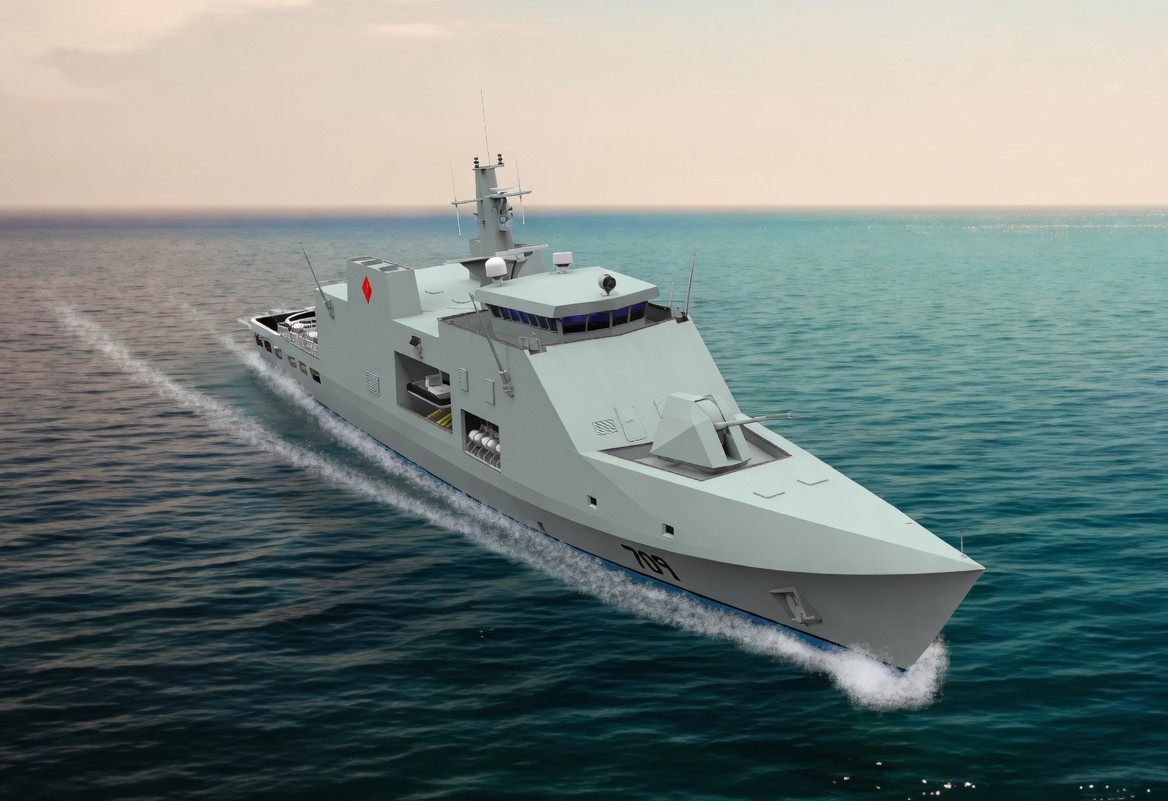
The Royal Canadian Navy (RCN) is taking the first concrete steps toward a major new warship program that could add up to 20 advanced corvettes to the fleet at a projected cost of $5 billion.
According to reporting by Defence Watch columnist David Pugliese in the Ottawa Citizen, the Canadian military has begun initial planning for what the navy is calling the Continental Defence Corvette — a versatile, multi-mission vessel designed to replace the aged-out Kingston-class Maritime Coastal Defence Vessels (MCDVs).
The Kingston-class fleet, consisting of 12 ships commissioned in the mid-1990s, has served primarily in coastal patrol, mine countermeasures, and training roles. However, many have reached the end of their service lives, with retirements having begun in late 2025. Navy leaders have long argued that a more capable replacement is needed to meet modern threats, including increased activity in the Arctic, potential hybrid warfare scenarios, and the need for distributed maritime presence along Canada’s vast coastlines.
A New Class of Warship for a Changing World
The proposed corvettes are envisioned as compact yet highly capable warships — roughly 100 metres in length — optimized for multi-role operations. While full technical specifications have not yet been publicly released, defence sources describe them as “multi-mission” platforms that would be more heavily armed and sensor-equipped than the Kingston Class, allowing them to conduct everything from sovereignty patrols and search-and-rescue to limited combat operations if required.
The project is being positioned as a “made-in-Canada” initiative, with expectations that Canadian shipyards, steel, and technology will play a central role. Industry engagement has already occurred, and further discussions with government officials and private-sector partners helped shape the decision to pursue a dedicated corvette class rather than simply extending the life of existing vessels or modifying larger surface combatants.
The total program value is estimated at $5 billion, covering design, construction, and initial support for the fleet. The first contract awards are targeted for around 2030, with the first new corvette potentially entering service in the early-to-mid 2030s. Up to 20 vessels could ultimately join the fleet, significantly expanding the RCN’s light surface combatant numbers and providing greater flexibility alongside the larger Canadian Surface Combatant (CSC) frigates currently under construction.
A concept rendering released by the navy depicts a sleek, modern corvette design featuring a low-profile superstructure, advanced radar arrays, and space for helicopters or unmanned systems — visual evidence of the RCN’s push toward a more capable, networked fleet.
Strategic Context and Naval Modernization
This initiative comes at a pivotal moment for Canadian defence policy. With renewed emphasis on NATO commitments, Arctic security, and Indo-Pacific engagement, senior naval officers have stressed the need for a more balanced fleet that includes both high-end destroyers/frigates and a larger number of affordable, agile corvettes.
The Continental Defence Corvette project is separate from the ongoing CSC program (which will deliver up to 15 larger warships) and builds on earlier studies into replacing the Kingston class. Defence analysts have welcomed the move, noting that corvettes offer an economical way to increase hull numbers — a critical factor in any future conflict where distributed operations across vast ocean areas become essential.
One defence industry source familiar with the discussions told Pugliese that the navy’s preference for a purpose-built corvette over simpler patrol vessels reflects a shift in strategic thinking: “In the new security environment, even coastal and offshore patrol ships need to be able to do more than just watch and report.”
Next Steps
The military will now move forward with detailed requirements definition, cost estimates, and further industry consultations. Procurement will likely follow a competitive process involving Canadian shipbuilders, with Irving Shipbuilding and Seaspan among the potential contenders, though no final decisions have been announced.
The project still requires formal approval through the government’s defence procurement process, but the fact that initial steps are already underway signals strong internal momentum within the Department of National Defence and the RCN.
For a navy that has spent decades operating with a relatively small fleet of surface combatants, the addition of up to 20 new corvettes would represent one of the most significant expansions in modern Canadian naval history — and a clear statement that Canada intends to play a more active role in maritime security at home and abroad.
As one senior officer put it in earlier internal discussions referenced in the reporting: the future fleet must be ready for “continental defence” in every sense of the word. With this new corvette program, that vision is now moving from concept to reality.

They should let me do a whole military redesign. That includes space technology.
It will be interesting to read of the requirements when they come out.
My thinking re:weapon systems and ASW, is if there is a desire to fit a Mk41 VLS forward, fit a helicopter deck and helicopter hanger , and fit a towed array, it will be a challenge to keep the the corvette to a length of 100 meters or less and keep it to a displacement of less than 4000 tons (where that is just an arbitrary displacement I noted). Its difficult to find a corvette sized vessel that exists currently and provides such at a typical ‘corvette’ size of 3,000 tons or less (and not light frigate size).
Instead, with VLS, helicopter hanger, and towed array one is getting into light frigate territory. And already one is reading of different potential consortium’s proposing light frigates in size (and calling them corvettes).
I note BAE have a ‘corvette’ depicted on their web site, where BAE are associated with providing Oman’s Khareef-class corvette. However that Khareef class corvette is unlikely to meet Canada’s requirements (mainly lacking in ASW functionality). BAE also proposed a stretched version of the Khareef class for the Type-31 program of the UK (and were not selected). I believe thou that that BAE stretched Khareef class (proposed for Type-31) may have a displacement much greater than 4,000 tons.
Still …
South Korea has a corvette (small frigate) which may be of interest, which is the South Korean (Hanwha Ocean and HD Hyundai Heavy Industries (HHI):) Daegu class frigate at about 3,100 tons (3,600 full load about) – however it exceeds 100 meters in length (wiki claims 122 meters in length). I note it has a BAE 5-inch gun forward, which could mean compatibility with the River Class for maintenance/support. It has a K-VLS forward instead of the heavy and larger in dimension Mk41 VLS (where I think the South Korean K-VLS can launch ESSM and SM-2 and Red Shark (ie an ASROC like missile)) and the Daegu class has a towed array aft. Carrying same ESSM as River Class could have maintenance/supply advantages.
I note Peru is procuring quantity two of these Daegu class frigates … although i think the Peru version hull length may be stretched a bit, and Peru is going for an Oto Melara 76mm instead of a BAE-5-inch gun, … and going for other changes.
Its not clear to me thou if the Ultra electronics towed array handling mechanism for the River Class would also fit on a modified/Canadianized Daegu class frigate instead, but it raises an interesting possibility. Also the Daegu class embarks a helicopter almost 1/2 the size of Canada’s CH-148 Cyclone helicopter, and its possible a modification required to fit a larger helicopter for any Canadian version. Although one needs to wait for requirements, perhaps the Canadian Corvette requirement will be an ASW capable uncrewed system (UAVs/USVs/UUVs)? (I prefer an actual helicopter but I don’t write the requirements nor pay for the warship)
And likely Canada would want to build such a corvette in Canada.
And as noted, many other consortiums are noting they can provide ‘corvettes’ (or in many cases light frigates and calling them corvettes) . Fitting potentially desired corvette functionality in a small corvette package will be a challenge and likely there will be compromises. I look forward very much to read of what is ultimately proposed.
It will be interesting to watch this evolve.
One further comment, which is directly relevant i believe, while I noted warships such as the BAE corvette ( Khareef class) and the small South Korean Daegu class frigate, the weapon systems and sensors to put on such warships are not cheap ,… and $5-Billion divided by 20 warships only leaves $250-million per warship, which, I believe, by today’s costs for warship, significantly restricts the weapons and sensors that can be put on such a warship.
The more I consider the $5-billion dollar budget the more I conclude that it could be a major limitation in terms of the Canadian Continental Corvette’s military equipment, where such equipment can be very expensive. Hence, in regards to trying to provide capable Canadian Continental Corvettes within a $5-billion budget, I speculate one possibility is there could be included (in the first and/or second batch of this corvette) substantial refurbished GFE from decommissioned Halifax class warships, where I speculate such could include::
(1)refurbished Bofors 57mm gun
(2)refurbished MASS ECM
(3)AN/SRD-506 ‘strongbow’ SIGINT
(4)Elisra NS9003A-V2HC ESM (assuming this is the Halifax class ESM)
(5)Towed array sonar (from Halifax class )
(6)Naval Remote Weapon Station (0.50 Cal NRWS)
Clearly this is speculation as to possible cost savings, and clearly those who know more about the Halifax class and the RCN planned Canadian Continental Corvette requirements will have a far better insight than my speculation.