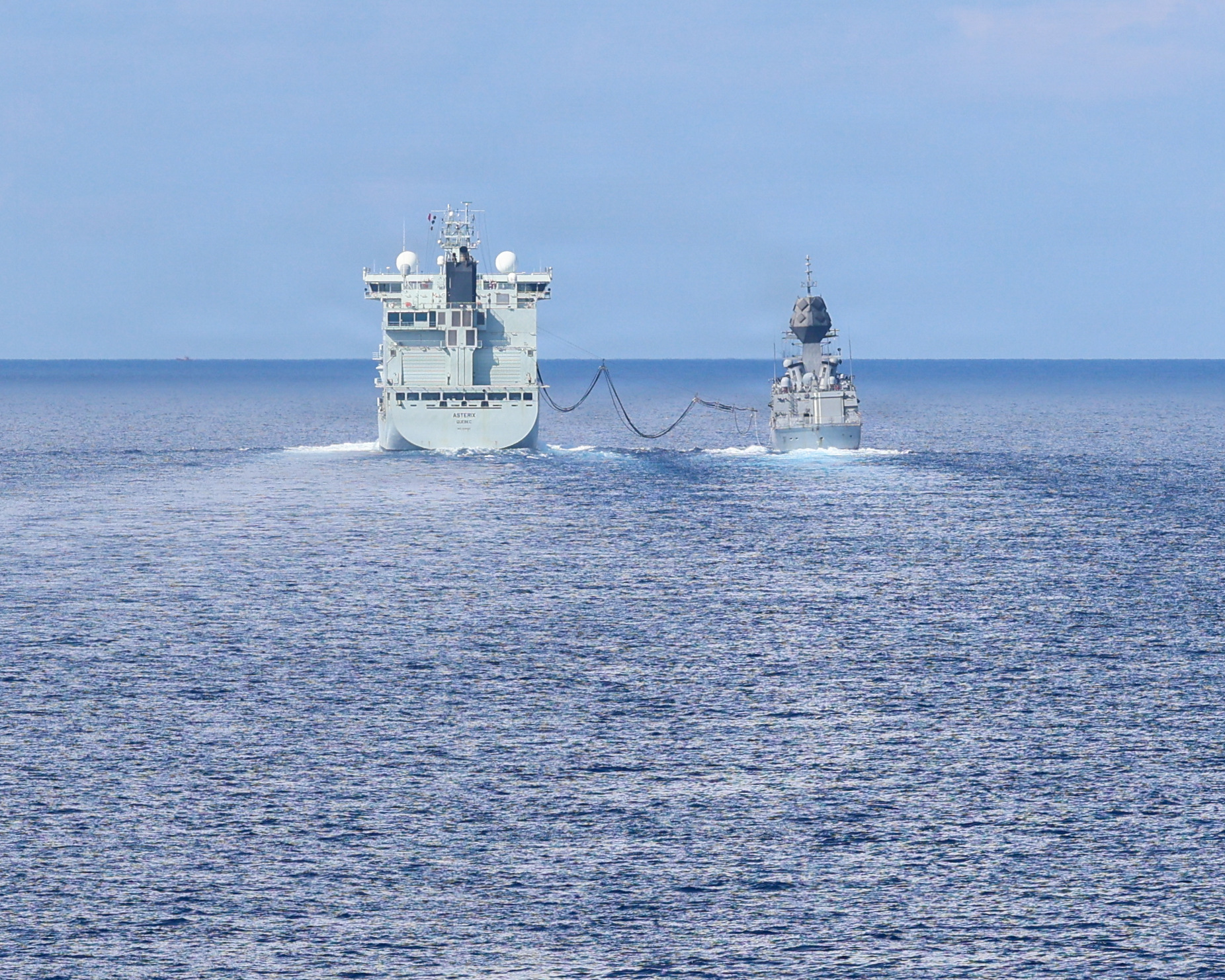
As June draws near, Canada is finalizing preparations to send a robust contingent to Exercise Rim of the Pacific 2026, the 30th edition of the planet’s biggest multinational maritime warfare drill.
Running from June 24 to July 31, 2026, in and around the Hawaiian Islands, this year’s RIMPAC will involve 31 nations, more than 25,000 personnel, approximately 40 surface ships, 5 submarines, and 140 aircraft. Canada, a founding member alongside the United States and Australia since 1971, has participated in every iteration and will once again play a leading role by commanding the air component of the exercise.
According to today’s announcement, the Canadian Armed Forces will deploy two Halifax class frigates, HMCS Regina and HMCS Ottawa, the replenishment ship MV Asterix, one CP 140 Aurora long-range maritime patrol aircraft, and two CH 148 Cyclone helicopters embarked aboard the frigates. These combined assets will represent more than 800 deployed Canadian Armed Forces personnel, including Royal Canadian Navy sailors, a team of clearance divers, a fleet cyber protection group, and medical emergency response teams operating in both land and sea based roles.
The Royal Canadian Navy intends to use the high-profile exercise to demonstrate recently acquired and upgraded systems in a realistic multinational environment. HMCS Regina will conduct a live firing of the Evolved Sea Sparrow Block II missile, which is Canada’s modern air defense weapon that uses its own onboard radar for terminal guidance, dramatically improving accuracy and response time against airborne threats. HMCS Ottawa will showcase its upgraded underwater warfare suite, including active intercept sensors and a powerful new towed low-frequency sonar array that allows submarine detection at far greater ranges in both open ocean and littoral environments.
Lieutenant Commander Linda Coleman, spokesperson for Canada’s Maritime Forces Pacific, explained that RIMPAC provides a valuable training environment for these systems. Throughout the exercise, Canadian sailors will take part in coordinated anti-submarine warfare exercises, working alongside allied ships and aircraft to locate and track submarines. This hands-on experience helps ensure crews are fully prepared to operate these advanced technologies in real-world scenarios. Major Anne Cote, spokesperson for Canadian Joint Operations Command, added that these combined assets are expected to represent over 800 deployed Canadian Armed Forces personnel, which highlights Canada’s ongoing commitment to promoting security and stability in the Indo-Pacific region.
Participants will train across the full spectrum of naval operations, including anti-submarine warfare, air defense, live fire gunnery and missile exercises, mine clearance, amphibious assaults, maritime security, humanitarian assistance and disaster relief, and more. The scale offers unparalleled opportunities for coalition tactics impossible to replicate at the national level.
For the Canadian Armed Forces, RIMPAC is much more than routine training. It directly supports Canada’s Indo Pacific Strategy by strengthening interoperability with key allies, honing high end warfighting skills, and visibly demonstrating Canada’s reliability as a security partner in a strategically critical region. As a consistent participant and now air component commander, Canada continues to punch above its weight, bringing unique capabilities and proven professionalism to the table.
Related posts:
HMCS Bonaventure’s Historic Resupply Mission to Cyprus: A Look Back at March 1964
HMCS William Hall Departs Halifax for Portsmouth to Join Royal Navy Exercise Tartan Lance
Admiral Topshee Urges RCN Submarine Decision by Year’s End