
HMCS TORONTO (2nd) (333)
HMCS TORONTO (2nd)
The History of HMCS TORONTO (2nd)
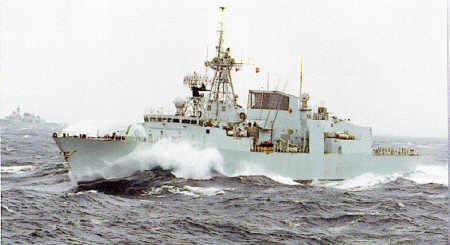
The currently operating HMCS Toronto (FFH 333) is a Halifax-class frigate in the Royal Canadian Navy (RCN), commissioned on July 29, 1993, at Toronto, Ontario, and named for the city. Built as part of the Canadian Patrol Frigate Project, it was designed to replace aging destroyer escorts, offering advanced multi-role capabilities for anti-submarine, anti-surface, and anti-air warfare. Homeported at CFB Halifax and assigned to Maritime Forces Atlantic, HMCS Toronto operates primarily in the Atlantic and Arctic Oceans, contributing to Canada's maritime sovereignty and international naval operations. With a complement of approximately 225 personnel, a top speed of 29 knots, and a range of 7,000 nautical miles, it has been a versatile asset since entering service, equipped with modern systems like Harpoon missiles, Evolved Sea Sparrow missiles, and advanced radar.
In its early years, HMCS Toronto participated in numerous NATO and international exercises, establishing its role in multinational operations. In 1995, it deployed to the Adriatic Sea to enforce the arms embargo during the Yugoslav Wars, showcasing its ability to operate in conflict zones. Throughout the late 1990s and early 2000s, it conducted fisheries patrols, sovereignty exercises, and training missions, including port visits across Europe and North America to strengthen diplomatic ties. In 2001, it joined Operation Apollo in the Arabian Sea, supporting Canada's contribution to the U.S.-led coalition in Afghanistan following the 9/11 attacks, conducting maritime interdiction and escort duties before returning in 2002.
From 2010 to 2012, HMCS Toronto underwent a significant mid-life refit under the Halifax Class Modernization program at Halifax Shipyard, upgrading its combat management system (CMS330), radar (Thales SMART-S Mk 2), and electronic warfare capabilities. Post-refit, it returned to active service with enhanced operational effectiveness. In 2014, it deployed to the Mediterranean and Black Seas as part of Operation Reassurance, NATO's response to Russian aggression in Ukraine, conducting patrols and joint exercises with allied navies. In 2019, it participated in Operation Projection in the Asia-Pacific, promoting maritime security and conducting freedom-of-navigation operations, including a transit through the Taiwan Strait alongside allied vessels.
More recently, HMCS Toronto has continued to play a key role in NATO and international missions. In 2022, it deployed to the Baltic Sea for Operation Reassurance, supporting NATO's deterrence efforts amid heightened tensions with Russia, and conducted joint exercises with European allies. In 2024, it underwent a docking work period to maintain its operational readiness. Equipped with the CH-148 Cyclone helicopter, advanced sonar, and upgraded missile systems, HMCS Toronto remains a critical component of the RCN's fleet, with plans to serve into the 2030s until replaced by the forthcoming River-class destroyers.
HMCS TORONTO (2nd) Statistical Data
- Pendant: 333
- Type: Canadian Patrol Frigate
- Class: Halifax
- Displacement: 5, 235 tonnes
- Length: 135.5 m / 444.5 ft
- Width: 16.4 m / 54 ft
- Draught: 6.15 m / 20 ft
- Speed: 29+ kts
- Compliment: 180 + 45 Transients Officers and Crew
- Arms: 8 Harpoon, 16 VL Sea Sparrow, 1 - 57 mm Bofors Mk. 2 DP, 1 - 20mm Phalanx CIWS, 4 - Mk. 32 12.75" TT, 6 - 12.7 mm M.G, 1 Helicopter.
- Builder: Saint John Shipbuilding, Saint John, NB
- Keel Laid: 24-Apr-89
- Date Launched: 18-Dec-90
- Date Commissioned: 29-Jul-93
- Paid off: