
HMCS ST. JOHN'S (340)
HMCS ST. JOHN'S
The History of HMCS ST. JOHN'S
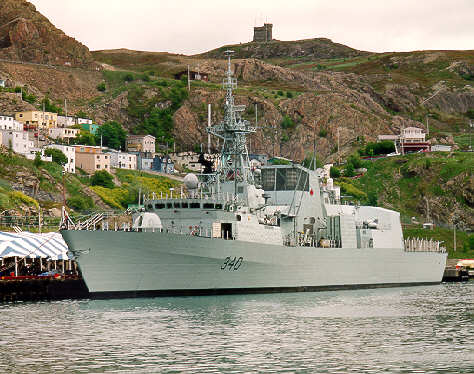
HMCS St. John's (FFH 340), a Halifax-class frigate, was commissioned into the Royal Canadian Navy (RCN) on June 24, 1996, in its namesake city of St. John's, Newfoundland and Labrador, becoming the first RCN ship to bear this name. Built by Saint John Shipbuilding Ltd. in New Brunswick as part of the Canadian Patrol Frigate Project, launched in 1977 to replace aging destroyer escorts, the frigate was designed as a multi-role warship with a focus on anti-submarine warfare, while also capable of anti-surface and anti-air operations. With a displacement of 4,750 long tons, a length of 134.6 meters, a maximum speed of 30 knots, and a crew of 225, it serves Maritime Forces Atlantic (MARLANT) from its homeport in Halifax, Nova Scotia, protecting Canada's Atlantic sovereignty and enforcing maritime laws.
In its early years, HMCS St. John's quickly integrated into international operations, joining NATO's Standing Naval Force Atlantic in August 1997 and returning in December after exercises in Norwegian waters during Exercise Strong Resolve in 1998. That same year, it joined the Standing Naval Force Mediterranean, returning to Halifax in December. In 1999, it conducted training in the Caribbean as part of Exercise UNITAS, followed by further deployments in 2002 to the Persian Gulf and Arabian Sea for Operation Apollo, supporting the U.S.-led coalition against terrorism. During this mission, it served as a temporary flagship, escorting ships through the Strait of Hormuz until HMCS Winnipeg arrived, concluding its deployment in November 2002. The frigate also excelled in interdiction operations, notably seizing 500 kg of cocaine in 2004 with the Royal Canadian Mounted Police and 6 tons of hashish in 2005 with other government agencies, earning NATO's Clean Sweep Award in 2004 for successfully firing missiles against high-speed aerial targets, a first for a non-U.S. navy.
The frigate's operational tempo remained high through the 2000s, with humanitarian and enforcement missions shaping its record. In 2005, alongside HMCS Athabaskan, Toronto, and the Canadian Coast Guard's Sir William Alexander, it aided recovery efforts in Louisiana following Hurricane Katrina. In 2008, it participated in Operation Caribbe, a U.S.-led multinational effort to combat drug trafficking in the Caribbean and eastern Pacific, and delivered 350 tonnes of relief supplies to Haiti after four hurricanes struck the nation. In 2010, it marked the RCN's centennial with Queen Elizabeth II inspecting a Guard of Honour onboard during Halifax's International Fleet Review. The following year, it joined Operation Nanook, a six-week Arctic sovereignty mission, visiting northern communities and conducting search-and-rescue and disaster response exercises with Canadian, American, and Danish ships.
HMCS St. John's faced challenges, including a 2013 oil spill during a fuel transfer in Halifax Harbour, resulting in a $100,000 fine for the RCN. That same year, its crew replaced HMCS Toronto's in Kuwait City for Operation Artemis, supporting Combined Task Force 150. The frigate underwent a significant refit under the Halifax Class Modernization (HCM) program, completed in October 2015 at Halifax Shipyards, upgrading its radar, combat systems, and weaponry, including Thales SPG-503 fire control radars, Raytheon AN/SPS-49 air search radar, and a modernized sonar suite. In 2017, it deployed to the Mediterranean with Standing NATO Maritime Group 2, patrolling the Black Sea and returning in July. In 2018, it joined Operation Reassurance, conducting exercises in the northern Atlantic, Baltic, and Mediterranean Seas, returning to Halifax in July after relieving HMCS Charlottetown.
In 2022, HMCS St. John's underwent further maintenance and modernization at Davie Shipbuilding in Quebec, focusing on hull, mechanical, and engineering improvements, and was delivered back to the RCN in November, sailing to Halifax under its own power. The frigate has since continued its role in NATO exercises, Arctic patrols, and anti-drug operations, notably in the Caribbean and Indian Ocean. Its storied history reflects a commitment to Canada's maritime security and international cooperation, with plans to serve until the 2030s when the River-class destroyers are expected to replace the Halifax-class frigates.
HMCS ST. JOHN'S Statistical Data
- Pendant: 340
- Type: Canadian Patrol Frigate
- Class: Halifax
- Displacement: 5, 235 tonnes
- Length: 135.5 m / 444.5 ft
- Width: 16.4 m / 54 ft
- Draught: 6.15 m / 20 ft
- Speed: 29+ kts
- Compliment: 180 + 45 Transients Officers and Crew
- Arms: 8 Harpoon, 16 VL Sea Sparrow, 1 - 57 mm Bofors Mk. 2 DP, 1 - 20mm Phalanx CIWS, 4 - Mk. 32 12.75" TT, 6 - 12.7 mm M.G, 1 Helicopter.
- Builder: Saint John Shipbuilding, Saint John, NB
- Keel Laid: 24-Aug-94
- Date Launched: 12-Feb-95
- Date Commissioned: 24-Jun-96
- Paid off: