
HMCS RESTIGOUCHE (1st) (H00)

HMCS RESTIGOUCHE (1st)
The History of HMCS RESTIGOUCHE (1st)
HMCS Restigouche (H00) began life as the British C-class destroyer HMS Comet, built at Portsmouth Dockyard. Laid down on 12 September 1930, launched on 30 September 1931, and completed on 2 June 1932, she served briefly with the Royal Navy before transfer to Canada.
Purchased by the Royal Canadian Navy, she was commissioned as HMCS Restigouche on 15 June 1938 at Chatham, United Kingdom, and renamed for the Restigouche River. After a short refit she sailed for the Pacific, arriving at Esquimalt, British Columbia, in November 1938. With the outbreak of war she transferred to Halifax, Nova Scotia, in November 1939 and began local escort duties, including the sailing of part of the 1st Canadian Infantry Division to Britain in December 1939.
On 24 May 1940 Restigouche left Halifax for Plymouth and joined Western Approaches Command. During the evacuation of French ports she helped recover survivors from the Canadian destroyer HMCS Fraser after that ship was rammed and sunk by HMS Calcutta on 25 June 1940. She then returned briefly to Canada for a refit before rejoining operations in the United Kingdom in early 1941.
In June 1941, Restigouchee was assigned to Newfoundland Command and spent the next two years as a mid-ocean escort, later joining Escort Group C-4. On 31 December 1941 she suffered serious storm damage en route to a convoy and required extensive repairs at Greenock. Throughout this period her armament was progressively modified for anti-submarine work, with guns and torpedo tubes removed to make room for Hedgehog projectors, additional depth charges, and improved radar and anti-aircraft weapons.
In May 1944 Restigouche joined Escort Group 12 for invasion duties. She supported the Normandy landings on D-Day and then conducted anti-submarine and surface patrols in the English Channel and Bay of Biscay from Plymouth. In early July 1944 she took part in an action off Brest in which the group sank a German patrol vessel.
She returned to Canada in September 1944 for a major refit at Saint John and Halifax, worked up in Bermuda, and reached Halifax again on 14 February 1945. For the remainder of the war she performed local escort duties. After VE-Day she spent three months ferrying Canadian military personnel home from Newfoundland.
Restigouche was paid off on 5 October 1945. She was sold for scrap and broken up the following year.
HMCS RESTIGOUCHE (1st) Statistical Data
- Pendant: H00
- Type: Destroyer
- Class: RIVER Class British
- Displacement: 1375 tonnes
- Length: 329 ft
- Width: 33 ft
- Draught: 10.2 ft
- Speed: 31 kts
- Compliment: 10 Officers and 171 Crew
- Arms: 4-4.7", 8-21" Torpedo Tube (2 x IV), 2-2 pdrs. Modified to 2-4.7", 1-3", 4-21" Torpedo Tubes (I x IV), 6-20mm and Hedgehog as war began.
- Builder: Portsmouth Naval Dockyard, Portsmouth, U.K.
- Keel Laid: 12-Sep-30
- Date Launched: 30-Sep-31
- Date Commissioned: 15-Jun-38
- Paid off: 06-Oct-45
Remarks
Ex HMS COMET
HMCS RESTIGOUCHE (1st) Photos
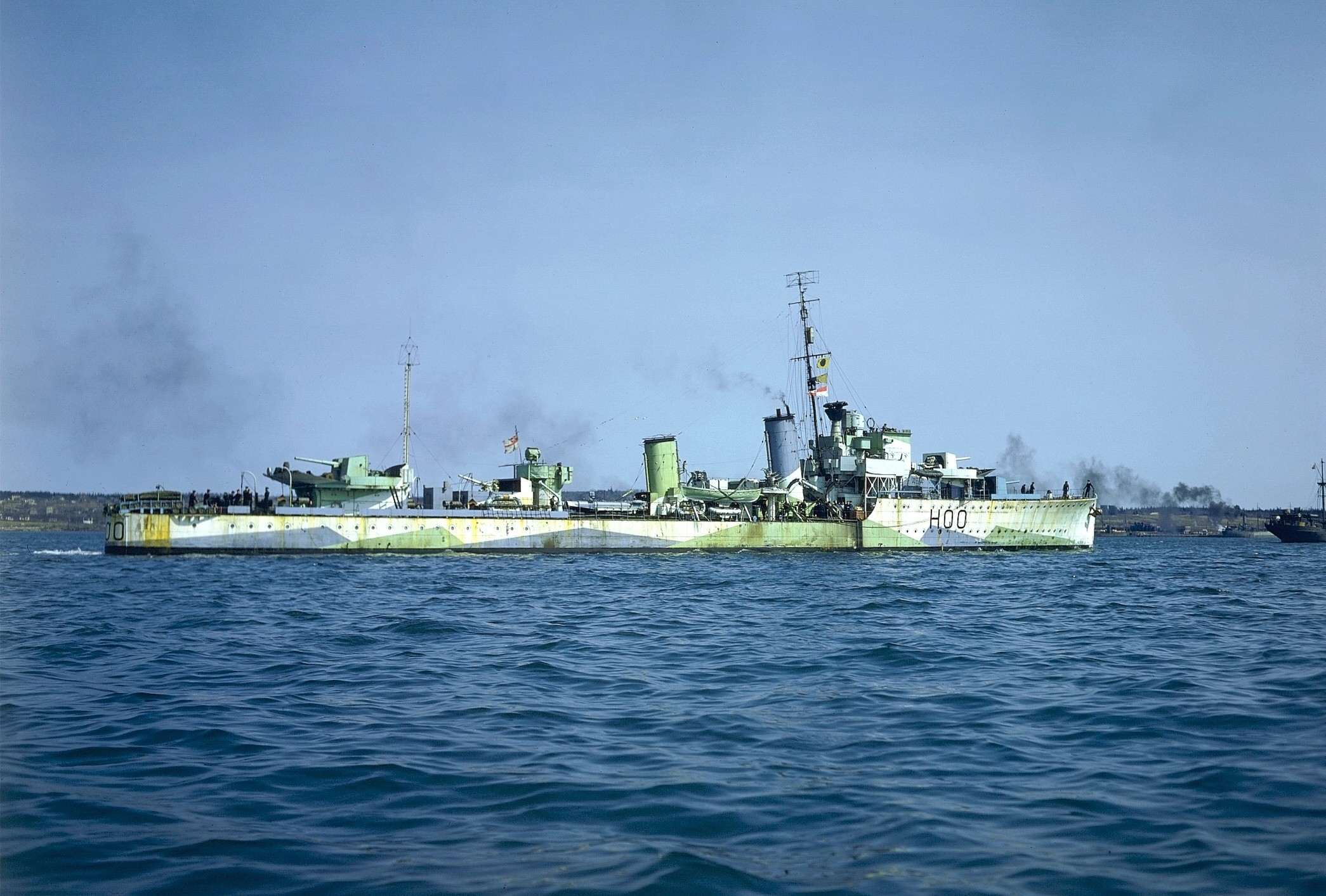
HMCS Restigouche (H00), circa 1944-1945. (Wikimedia Commons)
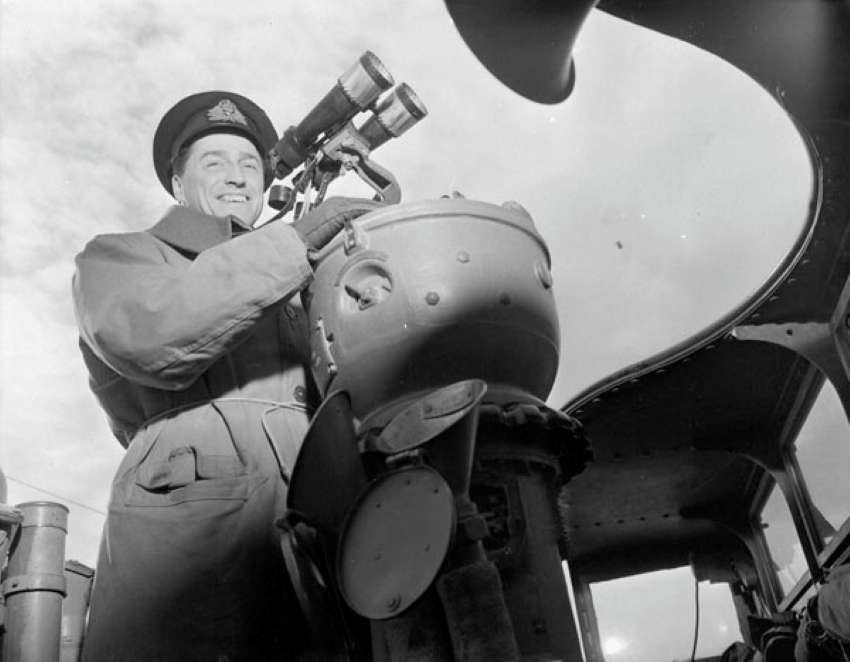
Lieutenant-Commander Desmond W. Piers, Commanding Officer, on the bridge of the destroyer HMCS Restigouche, which is escorting convoy SC 107 at sea, 21 April 1944. (Wikimedia Commons)
Keywords: HMCS RESTIGOUCHE (1st), Royal Canadian Navy Ship, Destroyer, RIVER Class British Class