
HMCS REGINA (2nd) (334)
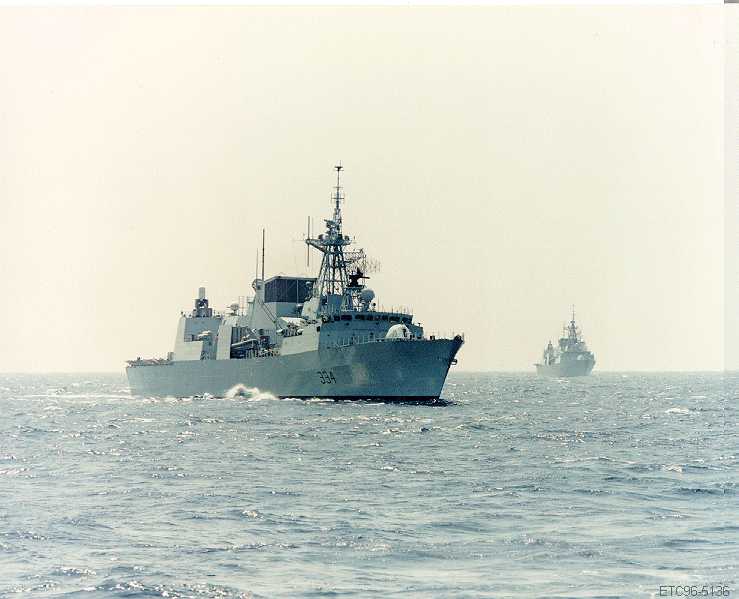
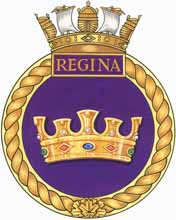
HMCS REGINA (2nd)
The History of HMCS REGINA (2nd)
The currently operating HMCS Regina (FFH 334) is a Halifax-class frigate in the Royal Canadian Navy (RCN), commissioned on December 29, 1993, in Vancouver, British Columbia, and named for the city of Regina, Saskatchewan. Built as part of the Canadian Patrol Frigate Project, it was designed to replace aging destroyer escorts, offering multi-role capabilities for anti-submarine, anti-surface, and anti-air warfare. Based at CFB Esquimalt on Canada's west coast and assigned to Maritime Forces Pacific, HMCS Regina has served in diverse missions across the Pacific and beyond, contributing to Canada's naval presence and international security efforts.
In its early years, HMCS Regina participated in multinational exercises and operations, establishing itself as a versatile asset. In 1997, it joined Exercise RIMPAC off Hawaii, showcasing interoperability with allied navies. The frigate saw significant action in 2001 when it deployed to the Arabian Sea for Operation Apollo, Canada's contribution to the U.S.-led coalition against terrorism following the September 11 attacks. During this deployment, it escorted merchant vessels, conducted boardings, and supported coalition efforts in Afghanistan, returning to Esquimalt in 2002. These missions highlighted its role in maintaining maritime security in volatile regions.
Between 2011 and 2013, HMCS Regina underwent a significant mid-life refit under the Halifax Class Modernization program at Esquimalt, receiving upgrades to its radar, command and control systems, and weaponry, including the Evolved Sea Sparrow missile system. Post-refit, it returned to active service, participating in exercises like RIMPAC in 2014 and 2016. In 2016, it was involved in Operation Neon, enforcing UN sanctions against North Korea's nuclear and missile programs, conducting patrols in the Indo-Pacific to monitor illicit ship-to-ship transfers. This role continued in subsequent deployments, reinforcing Canada's commitment to regional stability.
In 2019, HMCS Regina made headlines during a tense transit through the Taiwan Strait alongside HMCS Ottawa, shadowed by Chinese warships, underscoring its role in freedom-of-navigation operations. That year, it also participated in Operation Projection, promoting maritime security in the Asia-Pacific, and visited ports in Vietnam and Japan. In 2022, it joined RIMPAC again and continued sanctions enforcement against North Korea, operating with allied navies in the Indo-Pacific. By 2024, HMCS Regina was involved in Operation Horizon, conducting further patrols in the region, including a port visit to Japan, and participated in RIMPAC 2024, demonstrating advanced capabilities with its modernized systems.
With a complement of approximately 198 personnel, a maximum speed of 29 knots, and a range of 7,000 nautical miles, HMCS Regina remains a vital component of the RCN's Pacific fleet. Equipped with advanced systems like the CMS330 combat management system and Harpoon missiles, it continues to project Canadian influence in the Indo-Pacific, support NATO and UN objectives, and prepare for future challenges, with plans for eventual replacement by the River-class destroyers in the 2030s.
HMCS REGINA (2nd) Statistical Data
- Pendant: 334
- Type: Canadian Patrol Frigate
- Class: Halifax
- Displacement: 5, 235 tonnes
- Length: 135.5 m / 444.5 ft
- Width: 16.4 m / 54 ft
- Draught: 6.15 m / 20 ft
- Speed: 29+ kts
- Compliment: 180 + 45 Transients Officers and Crew
- Arms: 8 Harpoon, 16 VL Sea Sparrow, 1 - 57 mm Bofors Mk. 2 DP, 1 - 20mm Phalanx CIWS, 4 - Mk. 32 12.75" TT, 6 - 12.7 mm M.G, 1 Helicopter.
- Builder: Marine Industries Ltd., Sorel Quebec
- Keel Laid: 06-Oct-89
- Date Launched: 25-Oct-91
- Date Commissioned: 30-Sep-94
- Paid off: