
HMCS OTTAWA (4th) (341)
HMCS OTTAWA (4th)
The History of HMCS OTTAWA (4th)
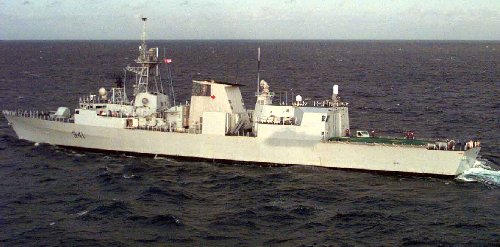
The currently operating HMCS Ottawa (FFH 341) is a Halifax-class frigate, the fourth vessel to bear the name in the Royal Canadian Navy (RCN), and the first named for Canada's capital city rather than the Ottawa River. Commissioned on September 28, 1996, at Cornwall, Ontario, it was constructed by Saint John Shipbuilding Ltd. in New Brunswick as part of the Canadian Patrol Frigate Project, which aimed to modernize the RCN's fleet with multi-role warships capable of anti-submarine, anti-surface, and anti-air operations. Launched on May 31, 1996, after being laid down on April 29, 1995, the frigate was assigned to Maritime Forces Pacific (MARPAC) and homeported at CFB Esquimalt, British Columbia, by late 1996. With a crew of approximately 240, including Royal Canadian Air Force personnel operating its CH-148 Cyclone helicopter, HMCS Ottawa has played a significant role in protecting Canada's Pacific sovereignty and contributing to international missions.
Shortly after commissioning, HMCS Ottawa embarked on its first major deployment in June 1998, joining the USS Abraham Lincoln Carrier Battle Group in the Persian Gulf to enforce a United Nations trade embargo against Iraq, marking the first time a Canadian vessel fully integrated with an American battle group. In February 2002, it deployed to the Arabian Sea for Operation Apollo, Canada's contribution to the War in Afghanistan, returning in August. The frigate's versatility was further demonstrated in 2011 during a four-and-a-half-month Pacific deployment, which included training exercises with the Royal Australian Navy and U.S. Seventh Fleet for Operation Talisman Saber, port visits to Australia, South Korea, Singapore, and Japan, and participation in San Diego's Fleet Week. In 2012, it joined the Rim of the Pacific (RIMPAC) exercise, a multinational maritime drill off Hawaii, enhancing interoperability with allied navies from nations like Australia, Japan, and the United States.
Between 2013 and 2016, HMCS Ottawa underwent a significant mid-life refit under the Halifax Class Modernization program, upgrading its radar, combat systems, and weaponry, including the Evolved Sea Sparrow missiles and Harpoon anti-ship missiles. In August 2016, it heroically rescued the crew of the burning fishing vessel Sherry C off British Columbia, safely transferring them to the Canadian Coast Guard. The following year, from March to August 2017, it conducted a six-month Pacific deployment, visiting nations such as Malaysia, India, China, and Japan. In 2018, it participated in RIMPAC alongside HMCS Vancouver and the supply ship Asterix. In 2019, it trained with the U.S. Navy and later deployed to the Asia-Pacific to enforce UN sanctions against North Korea, a mission it repeated in 2024.
Most recently, HMCS Ottawa completed a five-month deployment to the Indo-Pacific under Operations Horizon and Neon, returning to Esquimalt on March 24, 2025. During this mission, it conducted multinational exercises with allies including Japan, the United States, France, and the Philippines, and provided first aid training during a port visit to Cambodia.
HMCS OTTAWA (4th) Statistical Data
- Pendant: 341
- Type: Canadian Patrol Frigate
- Class: Halifax
- Displacement: 5, 235 tonnes
- Length: 135.5 m / 444.5 ft
- Width: 16.4 m / 54 ft
- Draught: 6.15 m / 20 ft
- Speed: 29+ kts
- Compliment: 180 + 45 Transients Officers and Crew
- Arms: 8 Harpoon, 16 VL Sea Sparrow, 1 - 57 mm Bofors Mk. 2 DP, 1 - 20mm Phalanx CIWS, 4 - Mk. 32 12.75" TT, 6 - 12.7 mm M.G, 1 Helicopter.
- Builder: Saint John Shipbuilding, Saint John, NB
- Keel Laid: 31-May-96
- Date Launched: 31-May-96
- Date Commissioned: 28-Sep-96
- Paid off: