
HMCS KOOTENAY (2nd) (258)

HMCS KOOTENAY (2nd)
The History of HMCS KOOTENAY (2nd)

HMCS Kootenay (DDE 258) was a Restigouche-class destroyer escort of the Royal Canadian Navy (later Canadian Forces Maritime Command). Named for the Kootenay River in British Columbia, she was the second ship to bear the name and served primarily in anti-submarine warfare roles during the Cold War from 1959 until her decommissioning in 1995. She is best remembered for the tragic engine-room explosion of 23 October 1969, the worst peacetime accident in Royal Canadian Navy history, and for the resilience of her crew in saving the ship. Her motto was "We are as one."
Kootenay was built by Burrard Dry Dock in North Vancouver, British Columbia. She was laid down on 21 August 1952, launched on 15 June 1954 (the first of her class), and commissioned on 7 March 1959 with pennant number DDE 258. She displaced roughly 2,000-2,500 tons, measured about 111-113 metres in length, and could reach 28 knots with a complement of around 214-249. Armament included twin 3-inch guns, Limbo anti-submarine mortars, and later ASROC and torpedoes after modernization.
After working up, she transferred to the Atlantic Fleet based in Halifax. One of her first notable duties was serving as Senior Officer Ship in the escort for the royal yacht HMY Britannia when Queen Elizabeth II opened the St. Lawrence Seaway in 1959. Through the 1960s she participated in NATO and other exercises, including events off Lisbon (1960) and with the U.S. Navy off Nova Scotia (1961), and was assigned to escort squadrons as the navy reorganized.
On 23 October 1969, Kootenay was part of a Canadian task group (including the aircraft carrier HMCS Bonaventure and other escorts) returning westward through the English Channel after exercises in United Kingdom waters. Roughly 200 miles (about 320 km) off Plymouth, she and HMCS Saguenay detached for routine full-power trials. Shortly after 08:10, while running at maximum speed, a bearing in the starboard gearbox failed. The insert bearing shells had been installed incorrectly during a refit years earlier, cutting off the oil supply. The oil overheated to an estimated 650C and exploded at about 08:21.
The blast and ensuing fire, with toxic smoke, killed nine crew members and injured 53 others. Of the men in the engine room, most were killed or severely burned; survivors elsewhere battled the blaze with limited equipment. Some ship's divers used SCUBA gear at great personal risk to help with rescue and firefighting. The ship continued at full speed in circles for a time because of the damage. The fire was brought under control by around 10:10 and extinguished between 10:30 and 11:00. The professional actions of the ship's company kept her afloat and prevented a greater disaster.
Kootenay was assisted by other ships in the group, towed to Plymouth for temporary repairs (with propellers later removed for the long tow), and arrived back in Halifax on 27 November 1969 under tow. A board of inquiry attributed the cause to the faulty installation of the bearing shells; no evidence of improper practice by the crew then aboard was found. Four of the deceased were buried in the United Kingdom (the last time Canadian military personnel were buried overseas in this manner), some at sea, and one later in Halifax; the tragedy prompted a change in Canadian policy toward repatriating the remains of service personnel. Chief Petty Officer Vaino Olavi Partanen and Petty Officer Lewis John Stringer were among those posthumously awarded the Cross of Valour for their heroism.
While under repair, the ship underwent conversion to Improved Restigouche-class (IRE) configuration. This added a variable-depth sonar, an ASROC launcher (replacing some earlier weapons), an updated mast and sensors, and other enhancements for anti-submarine work. She was recommissioned on 7 January 1972. In early 1973 she transferred to the Pacific Fleet at Esquimalt, British Columbia, arriving on 12 February and joining the Second Squadron.
On the West Coast she continued routine training, exercises (including RIMPAC), and operational deployments. Notable activities included a 1973 role supporting Canadian observers related to the International Commission of Control and Supervision near Vietnam; assisting in a major drug interdiction in 1978; tracking Soviet forces in the Gulf of Alaska in 1981; a visit to Vladivostok in June 1990 as part of a Canadian task group (the first such visit since the Second World War); and participation in the enforcement of United Nations sanctions against Haiti in 1994. She also completed a Destroyer Life Extension (DELEX) refit (finished around October 1983) that updated sensors, combat data systems, and torpedo systems. In 1989 she collided in fog with the merchant vessel MV Nord Pol off Cape Flattery, sustaining bow damage that was repaired by grafting on a bow section from the decommissioned sister ship HMCS Chaudiere. Her final major deployment involved the UNITAS exercise, including a transit near Cape Horn.
Kootenay was paid off on 18 December 1995 after more than 36 years of service. On 6 November 2000 she was towed from Esquimalt and later sunk as an artificial reef off Puerto Vallarta, Mexico. Her bell is held by the CFB Esquimalt Naval & Military Museum.
The 1969 disaster led to lasting improvements in damage-control training, firefighting equipment placement, inspections, and procedures across the Canadian Navy. The Damage Control Training Facility at Naval Fleet School Atlantic was named DCTF Kootenay in her honour. Annual memorials remember the nine who died and the many who were injured, and the ship's story remains a touchstone for lessons in seamanship, bravery, and preparedness.
HMCS KOOTENAY (2nd) Statistical Data
- Pendant: 258
- Type: Destroyer Escort
- Class: Restigouche
- Displacement: 2,366 / 2,390 (post refit) tonnes
- Length: 366 / 372 (post refit) ft
- Width: 42 ft
- Draught: 13.5 / 14.1 (post refit) ft
- Speed: 28 kts
- Compliment: 12 Officers and 237 Crew
- Arms: 4 - 3" (2 x II), 2 Limbo, Homing Torpedoes. After IRE refit: 2-3" (1 x II), 1 Limbo, 1 ASROC, Homing Torpedoes.
- Builder: Burrard D.D. Co., Vancouver
- Keel Laid: 21-Aug-52
- Date Launched: 16-Jun-54
- Date Commissioned: 07-Mar-59
- Paid off: 18-Nov-95
Remarks
Modified as Improved Restigouche Class 1970-1972. DELEX refit in 1984.
Photos
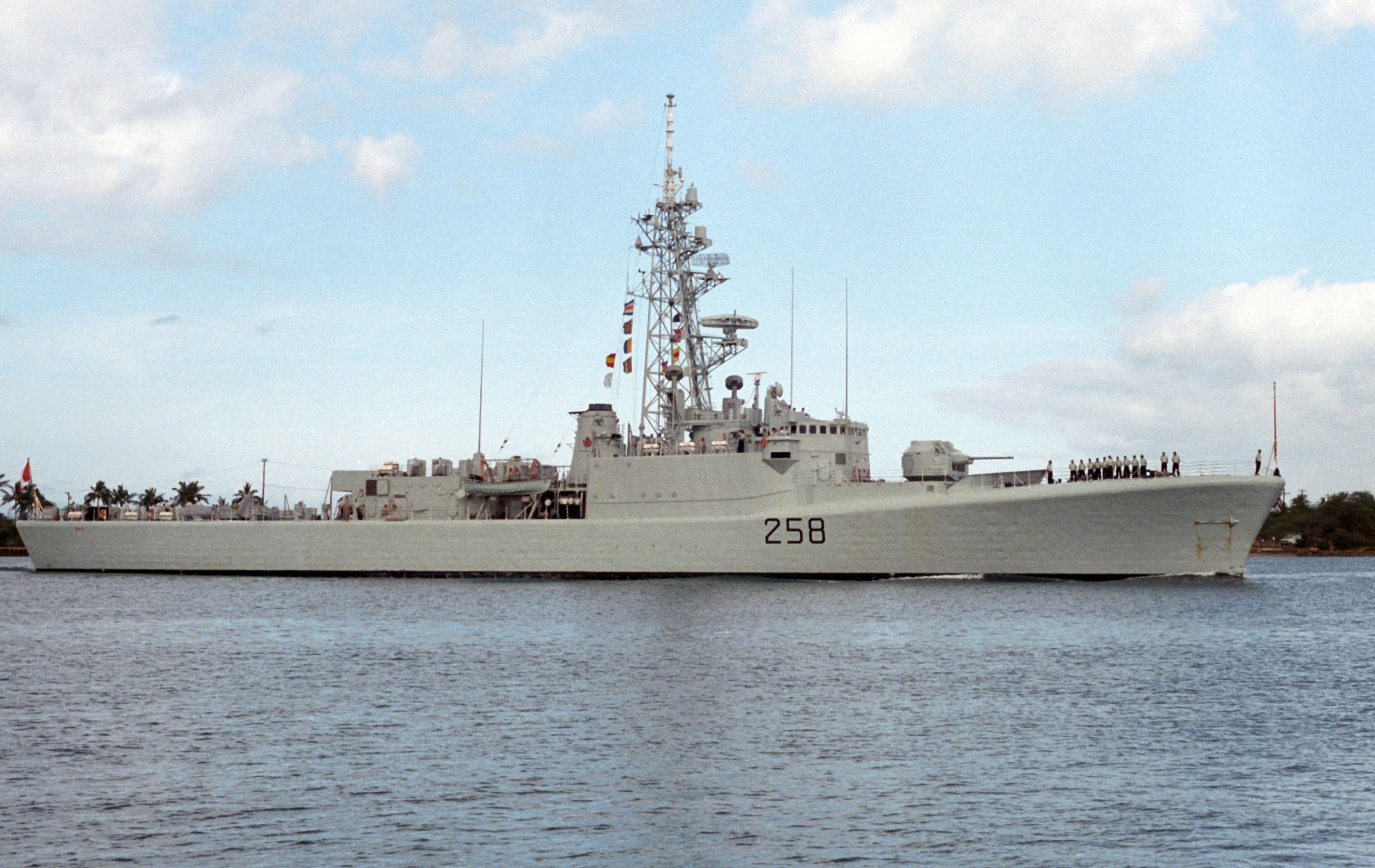
HMCS Kootenay (DDE 258) underway at Pearl Harbor, Hawaii, Exercise RIMPAC 86, 1 June 1986.
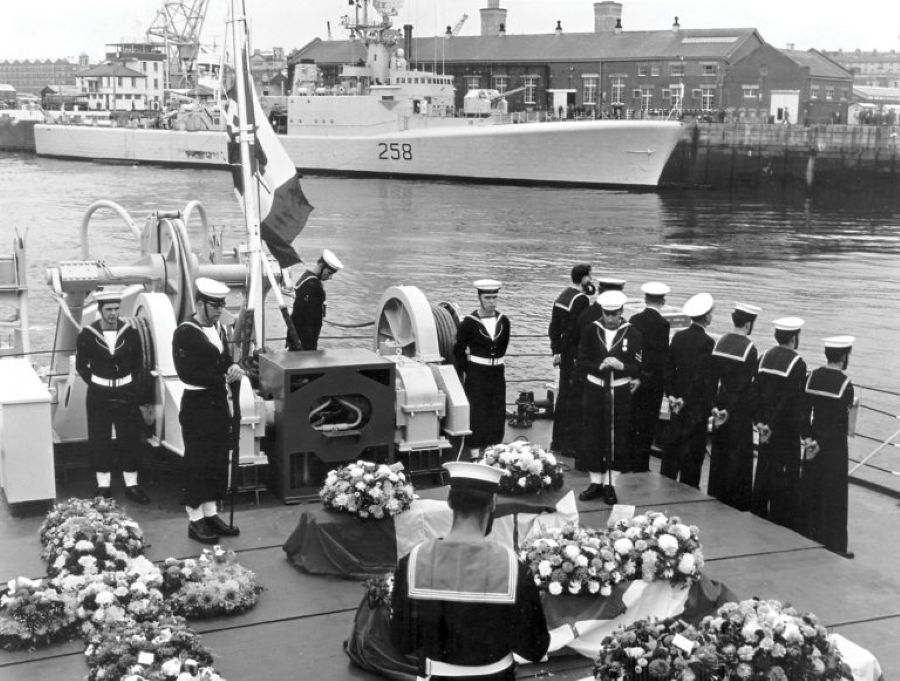
A funeral service on the quarterdeck of HMCS Saguenay in Plymouth, England. The fire-damaged Kootenay is in the background, with scorch marks on the starboard side amidships. [DND]
Keywords: HMCS KOOTENAY (2nd), Royal Canadian Navy Ship, Destroyer Escort, Restigouche Class