
HMCS ETTRICK (K254)

HMCS ETTRICK
The History of HMCS ETTRICK
HMCS Ettrick (K254) was a River-class frigate that served briefly in the Royal Canadian Navy during the Second World War. Named for the Ettrick Water (a river) in Scotland, she was the only vessel of that name in the RCN.
Ordered on 1 June 1941, she was laid down on 31 December 1941 by John Crown & Sons Ltd. at Sunderland, United Kingdom, and launched on 5 February 1943. Completed and commissioned into the Royal Navy as HMS Ettrick on 11 July 1943, she was one of only six River-class frigates fitted with steam turbines instead of the usual reciprocating engines.
She joined the Mid-Ocean Escort Force with Canadian escort group C-1 for Atlantic convoy defence. From December 1943 until her transfer she was commanded by Lieutenant Commander Nicholas Monsarrat, who later drew on the experience for the fictional HMS River in his 1946 novel H.M. Frigate.
On 29 January 1944, while undergoing a refit in Halifax, Nova Scotia, she was transferred to the Royal Canadian Navy and commissioned as HMCS Ettrick. The refit finished on 6 May 1944, after which she was assigned to escort group C-3. She worked up in Bermuda in September-October 1944, then made two round trips to Londonderry with C-3 before transferring in October to escort group 27 based at Halifax. She spent the rest of the war on local escort duties off the Canadian coast.
On 14 January 1945, while defending convoy BX 141, HMCS Ettrick rammed the German U-boat U-1232 and damaged its conning tower; the submarine escaped. She remained in service until the end of the war in Europe.
Paid off on 30 May 1945, she was returned to the Royal Navy at Southampton. Converted for use as a combined operations headquarters ship, she was never employed in that role. Laid up at Harwich in April 1946, she was broken up at Grays, Essex, in 1953.
HMCS ETTRICK Statistical Data
- Pendant: K254
- Type: Frigate
- Class: RIVER Class EX-RN
- Displacement: 1445 tonnes
- Length: 301.5 ft
- Width: 36.6 ft
- Draught: 9 ft
- Speed: 19 kts
- Compliment: 8 Officers and 133 Crew
- Arms: 2-4" (1 x II), 4-20mm, Hedgehog
- Builder: John Crown & Sons Ltd., Sunderland, U.K.
- Keel Laid: 31-Dec-41
- Date Launched: 5-Feb-43
- Date Commissioned: 29-Jan-44
- Paid off: 30-May-45
HMCS ETTRICK Photos
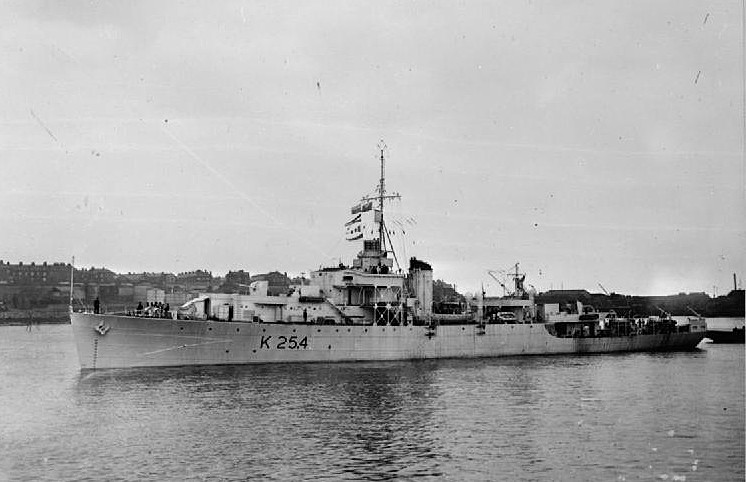
Photograph of River class frigate HMS Ettrick. (Imperial War Museum)
Keywords: HMCS ETTRICK, Royal Canadian Navy Ship, Frigate, RIVER Class EX-RN Class