
HMCS CAYUGA (R04 / Postwar-218)

HMCS CAYUGA
The History of HMCS CAYUGA

HMCS Cayuga (R04 / 218) was the only vessel of that name in the Royal Canadian Navy. Named for the Cayuga First Nation, one of the original members of the Haudenosaunee (Iroquois) Confederacy, she was a Tribal-class destroyer built too late for Second World War service but which saw extensive action in the Korean War.
Ordered in April 1942 as part of Canada's wartime programme, she was laid down on 7 October 1943 at Halifax Shipyards Ltd. in Halifax, Nova Scotia, and launched on 28 July 1945. She was commissioned at Halifax on 20 October 1947 with pennant number R04. Although built on the east coast, she was intended for Pacific service and sailed for her base at Esquimalt, British Columbia, on 4 February 1948.
In the late 1940s she conducted training and exercises, including a large post-war deployment to Pearl Harbor, Hawaii, in October 1948 with other Canadian ships, and a training cruise to Mexico in early 1950. In February 1950 she took part in the search for a missing U.S. Air Force B-36 bomber that had gone down in the Hecate Strait area off British Columbia; her landing parties helped locate and recover survivors.
With the outbreak of the Korean War, Cayuga left Esquimalt on 5 July 1950 as Senior Officer's ship of the first three Canadian destroyers (with HMCS Athabaskan and HMCS Sioux) sent to Korean waters. She completed three tours of duty there, the last in 1954 after the armistice. Notable actions included leading a hazardous night navigation up the mined and shallow Taedong River in early December 1950 to support the UN evacuation of Chinnampo (Nampo), the port for Pyongyang. Under Captain Jeffry Brock, she and other destroyers covered the withdrawal of thousands of personnel and later bombarded installations; her navigation officer, Lieutenant Andrew Collier, received the Distinguished Service Cross for the precision of his radar fixes during the passage. She also supported operations around Inchon, conducted coastal patrols, island-defence duties, and shore bombardments. Between her second and third tours, in 1952, she was rebuilt as a destroyer escort and re-numbered 218 (or DDE 218), with armament updated to include Squid anti-submarine mortars.
After returning from Korea in December 1954, Cayuga spent the next four years on training duties on Canada's west coast. She transferred to Halifax in January 1959 and continued in a training role for five more years.
She was paid off at Halifax on 27 February 1964 and broken up at Faslane, Scotland, the following year.
HMCS CAYUGA Statistical Data
- Pendant: R04 / Postwar-218
- Type: Destroyer
- Class: TRIBAL 1940s
- Displacement: 2,200 tonnes
- Length: 355.5 ft
- Width: 37.5 ft
- Draught: 11.2 ft
- Speed: 32 kts
- Compliment: 14 Officers and 245 Crew
- Arms: 6 - 4.7" (3XII), 2 - 4" (IxII), 4 - 2 pdrs (1xIV), 6 - 20mm, 4 - 21" TT (1xIV). Revised: 4 - 4" (2xII), 2 - 3" (1xII), 4 - 40mm, 4 - 21"TT (1XIV), 2 x Squid.
- Builder: Halifax Shipyards Ltd., Halifax, NS
- Keel Laid: 07-Oct-43
- Date Launched: 28-Jul-45
- Date Commissioned: 20-Oct-47
- Paid off: 27-Feb-64
Remarks
It was on the Cayuga that Ferdinand Demara, "the great impostor", served while impersonating a Canadian medical officer.
HMCS CAYUGA Photos
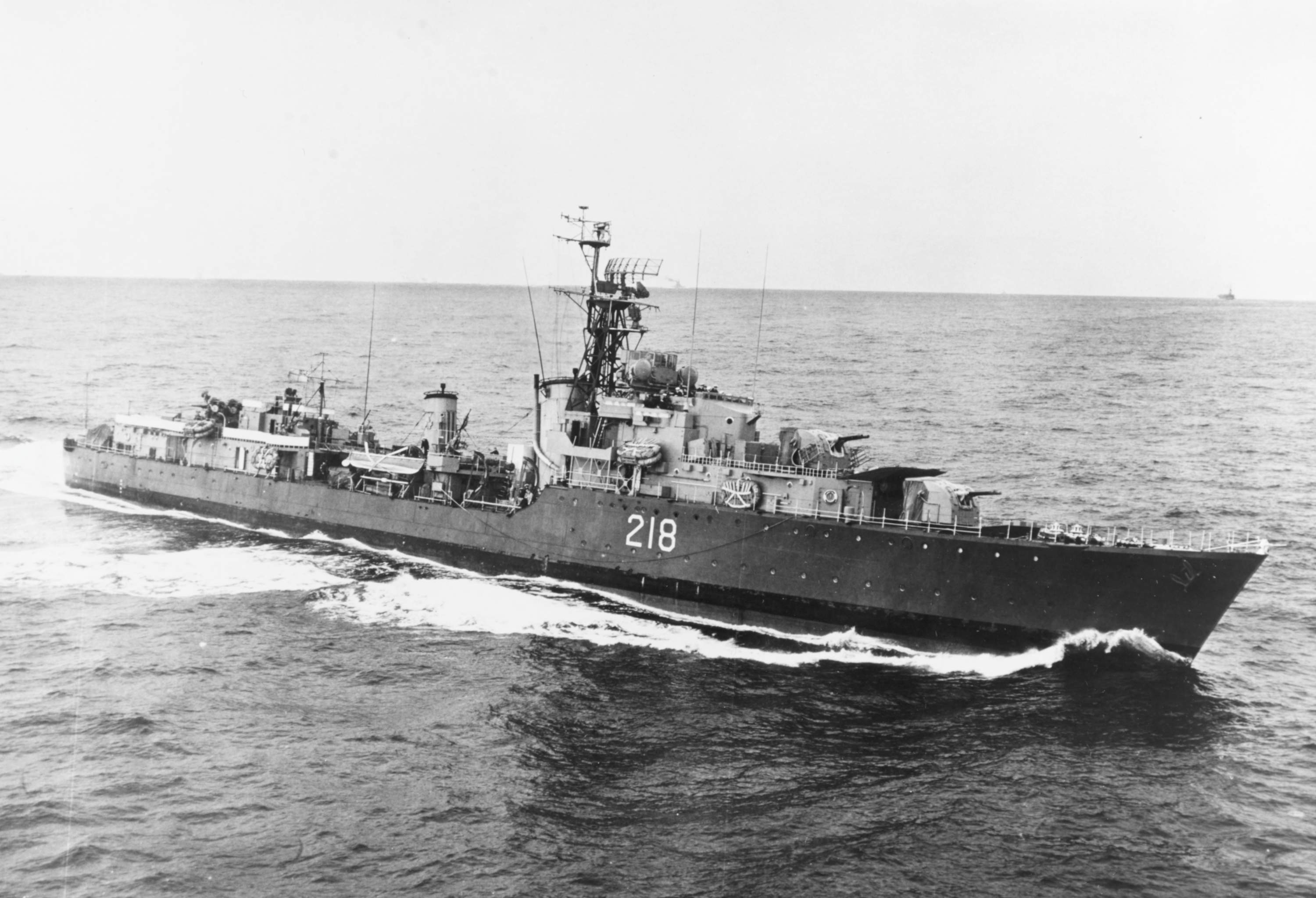
HMCS Cayuga underway off Korea, on 3 March 1954. (National Archives)
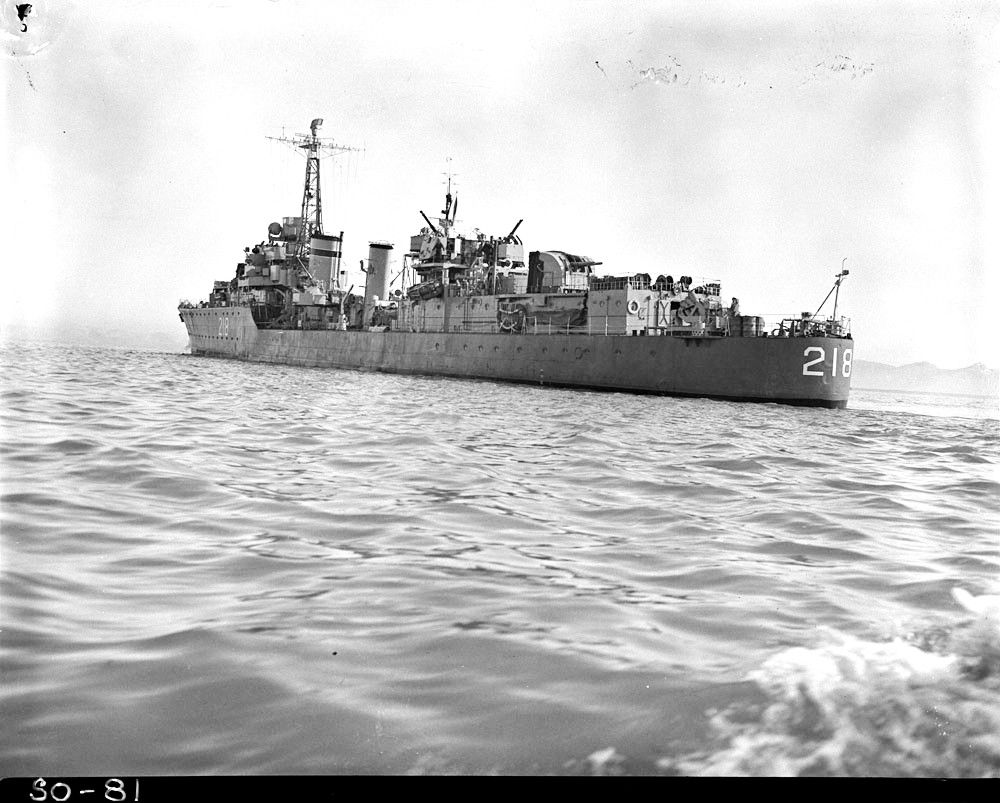
HMCS Cayuga off North Korean Coast, 1952 (Library and Archives Canada)
Keywords: HMCS CAYUGA, Royal Canadian Navy Ship, Destroyer, TRIBAL 1940s Class