
HMCS ATHABASKAN (1st) (G07)

HMCS ATHABASKAN (1st)
The History of HMCS ATHABASKAN (1st)
HMCS Athabaskan (G07) was the first of three Royal Canadian Navy destroyers to bear the name, honoring the Athabaskan First Nations language group. She was a Tribal-class destroyer ordered on 5 April 1940 as part of the 1940-1941 building program and laid down on 31 October 1940 at Vickers-Armstrongs in High Walker, Newcastle upon Tyne, United Kingdom. Originally intended to be named Iroquois, she was launched as Athabaskan on 18 November 1941 by Lady Tweedsmuir and commissioned into the Royal Canadian Navy on 3 February 1943. She never visited Canadian waters during her service.
Her specifications included a standard displacement of about 1,927 to 1,990 tons, a length of 377 feet, a beam of 37 feet 6 inches, geared turbine propulsion for a top speed of around 36 knots, and a main armament of six 4.7-inch guns in three twin mounts, supplemented by dual-purpose 4-inch guns, anti-aircraft weapons, torpedo tubes, and depth charges.
After working up, Athabaskan was assigned to the British Home Fleet. Her first operational task, beginning in late March 1943, was a patrol of the Iceland-Faeroes Passage for blockade runners. Heavy weather caused hull damage that required five weeks of repairs at South Shields. In June 1943 she took part in Operation Gearbox III, the relief of the Allied garrison at Spitsbergen. On 18 June 1943 she collided with the boom defence vessel Bargate at Scapa Flow, leading to further repairs at Devonport. She then conducted anti-submarine patrols in the Bay of Biscay.
On 27 August 1943, while operating off Cape Ortegal on the Spanish coast, Athabaskan was struck by a Henschel Hs 293 glider bomb dropped by German aircraft. The bomb passed through the ship and detonated, causing severe damage that flooded a boiler room and fuel tanks; five crew members were killed. She reached Devonport under her own power and remained under repair until November 1943. After returning to service she escorted Arctic convoys to the Soviet Union, including convoy JW55A. In early 1944 she joined the 10th Destroyer Flotilla at Plymouth for operations in the English Channel.
On the night of 25-26 April 1944, Athabaskan, operating with HMCS Haida and other ships, helped sink the German torpedo boat T29 off the coast of France. Three nights later, on 29 April 1944, she and Haida were supporting a minelaying operation north of Ile de Bas (near Ile de Batz) when they intercepted German torpedo boats. Athabaskan was hit by a torpedo from T24 at about 0417 hours. A second explosion followed, and the ship sank rapidly. Lieutenant Commander John Hamilton Stubbs, her commanding officer, was lost after refusing rescue so that he could continue assisting his men in the water. Official Canadian accounts state that the captain and 127 men were lost, 85 were taken prisoner by German forces, 42 were rescued by Haida, and six others reached England in a small craft. The loss of Athabaskan was the largest single-ship casualty suffered by the Royal Canadian Navy in the Second World War. She earned the battle honours Arctic 1943-44 and English Channel 1944.
The wreck was located in 2002 near Ile de Batz and is protected under the French Heritage Code as a war grave. In 2004, the Royal Canadian Navy provided a brass plaque to be laid on the wreck to commemorate the loss.
The name Athabaskan was soon given to a second Tribal-class destroyer, continuing the tradition.
HMCS ATHABASKAN (1st) Statistical Data
- Pendant: G07
- Type: Destroyer
- Class: TRIBAL 1940s
- Displacement: 1927 tonnes
- Length: 377 ft
- Width: 37.5 ft
- Draught: 11.2 ft
- Speed: 36 kts
- Compliment: 14 Officers and 245 Crew
- Arms: 6-4.7" (3 x II), 2-4" (1 xII), 4-21" Torpedo Tube (1 x IV), 4-2 pdrs., 6-20mm.
- Builder: Vickers-Armstrongs Ltd., Newcastle-on-Tyne. U.K.
- Keel Laid: 31-Oct-40
- Date Launched: 18-Nov-41
- Date Commissioned: 03-Feb-43
- Paid off: 29-Apr-44
Remarks
Lost 29 Apr 44. Sunk by a torpedo from German torpedo boat T24, while operating in the English Channel.
Photos
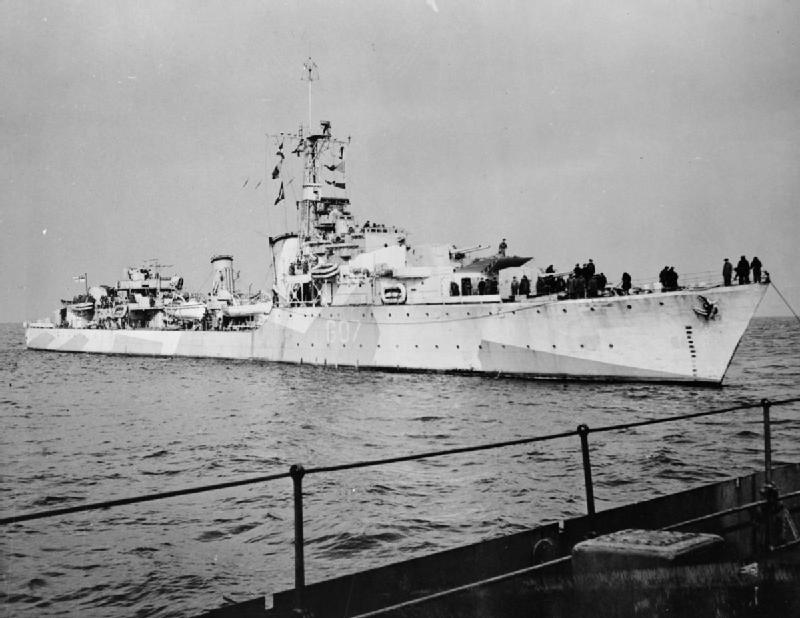
Tribal class destroyer HMCS Athabaskan (G07), date estimated between November 1943 and April 1944. (Royal Navy official photographer, photo A22987 Imperial War Museums.)
Keywords: HMCS ATHABASKAN (1st), Royal Canadian Navy Ship, Destroyer, TRIBAL 1940s Class