

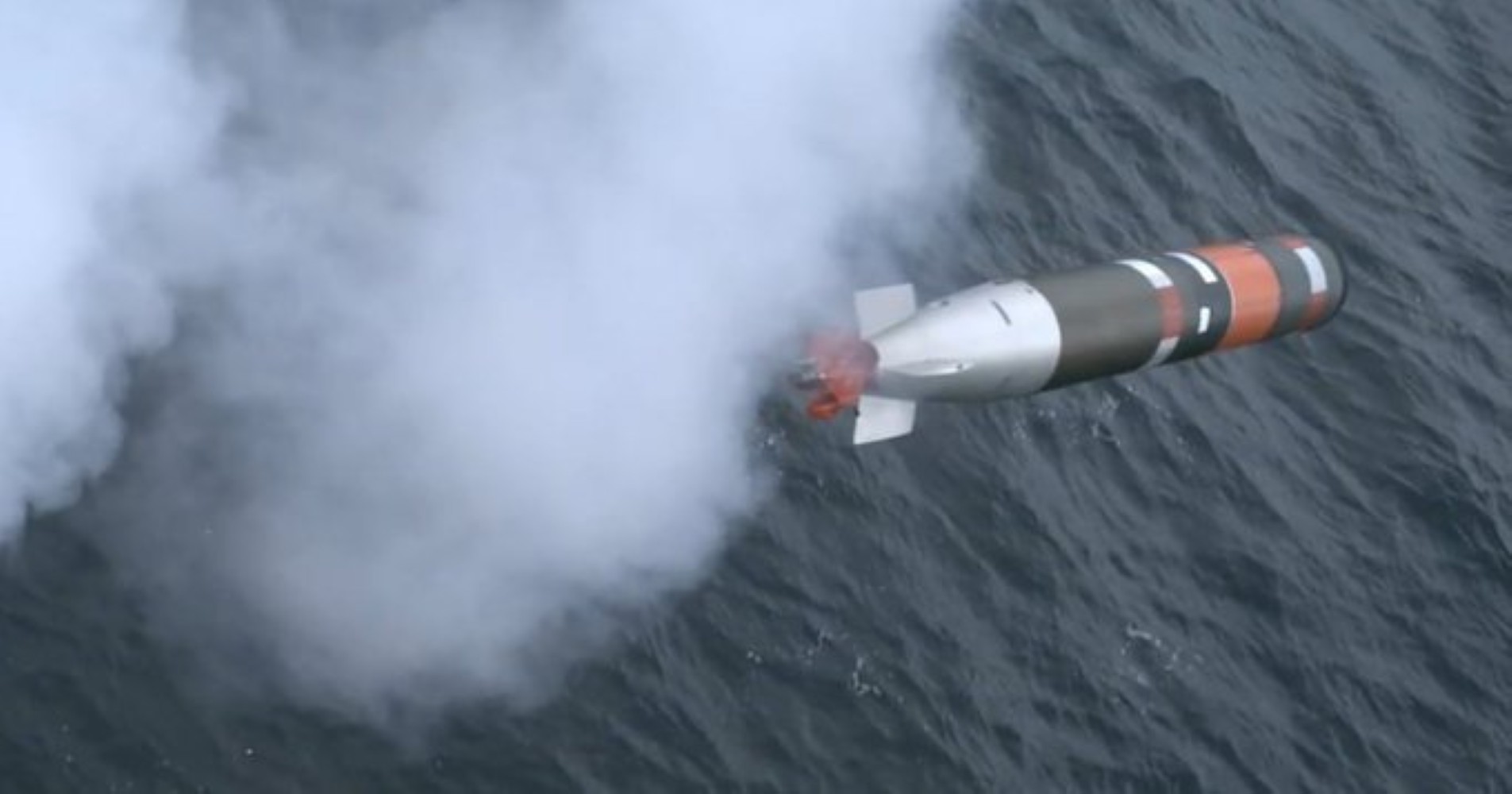
In a significant advancement for Canada’s maritime defense capabilities, the Royal Canadian Navy (RCN) recently conducted a live test firing of the U.S.-made Mark 54 lightweight anti-submarine torpedo. The event took place at the Canadian Forces Maritime Experimental and Test Ranges (CFMETR) near Nanoose Bay, British Columbia, between February 2 and 4, 2026. This test represents the first at-sea launch of the Mark 54 from a Halifax-class frigate, underscoring ongoing efforts to modernize the navy’s fleet amid evolving global security challenges.
The torpedo was launched from HMCS Regina (FFH 334), a Halifax-class frigate, targeting a stationary underwater objective. The primary objectives of the trial included validating launch procedures, assessing shipboard detection and fire control sequencing, and gathering performance data on the torpedo’s behavior post-launch. This data will inform future upgrades and ensure seamless integration with the frigate’s upgraded combat management system, sonar suite, and weapon control architecture. Cmdr. Darren Sleen, commanding officer of HMCS Regina, highlighted the achievement, stating, “These trials not only showcase the professionalism of our sailors, but also directly contribute to our warfighting credibility and support our relentless pursuit of personnel generation.”
The Mark 54 torpedo, developed by Raytheon in collaboration with the U.S. Navy and in production since 2004, is a 324 mm lightweight weapon optimized for anti-submarine warfare in both deep and shallow waters. It combines the propulsion and warhead of the older Mark 46 with advanced guidance and sonar processing from the Mark 50, offering enhanced performance against diesel-electric submarines in littoral environments. Weighing 608 pounds (276 kilograms) and measuring 8 feet (2 meters) long with a 13-inch (33-centimeter) diameter, the torpedo achieves speeds over 40 knots (74 kilometers per hour) and operates at depths exceeding 450 meters (1,476 feet). Its design includes active and passive sonar modes, improved counter-countermeasure capabilities, and resistance to acoustic decoys.
This test is part of Canada’s broader Halifax-class modernization program, which aims to upgrade combat systems, sensors, and weapons across all 12 frigates to sustain operational relevance into the 2030s. In 2019, Canada acquired 425 Mark 54 conversion kits from the United States under a Foreign Military Sales agreement valued at approximately $514 million, with each kit costing about $1.2 million. These kits upgrade existing Mark 46 torpedoes by incorporating updated guidance electronics and signal processing, replacing Cold War-era technology. The U.S. State Department approved the sale in May 2019, and it proceeded without congressional intervention.
Beyond the frigates, the Mark 54 will be integrated into other RCN platforms, including the CP-140 Aurora maritime patrol aircraft and the CH-148 Cyclone helicopters, enhancing interoperability and logistical efficiency. This compatibility supports layered defense strategies in distributed maritime operations, bolstering Canada’s ability to counter modern submarine threats in the North Atlantic, Arctic, and Pacific regions. The upgrade also strengthens alliances, as the torpedo is used by the U.S. and other NATO partners, facilitating joint exercises and shared logistics.
The successful test at Nanoose Bay not only validates the Mark 54’s integration but also reinforces Canada’s commitment to maintaining a credible naval presence. As geopolitical tensions rise, particularly in contested maritime domains, this milestone ensures the RCN remains equipped to protect national interests and contribute to international stability. Future evaluations will pave the way for full operational deployment across the fleet, marking a new era in Canadian anti-submarine warfare.
