


Every newly commissioned warship in the Royal Canadian Navy (RCN) is honoured with an official ship’s badge based on the ship’s name and designed with heraldic elements. The badge serves as a unifying symbol for the ship’s company.

However, HMC ship’s commissioned prior to the end of World War II were not normally honoured with an official badge, and thus there were no official controls over the badge a Canadian warship might wear. During the Second World War, with Commanding Officers and crew members coming up with their own designs, it was common to witness ships emblazoned with Donald Duck, as in HMCS Snowberry, or an image of St. Clair blasting a U-boat with lightning flashing from her fingertips, as in HMCS St. Clair. HMCS St. Laurent, a ship nicknamed “Sally Rand”, had a picture of the famous burlesque dancer knocking down dive bombers with her fan. HMCS Wetaskiwin displayed an image of the Queen of Hearts sitting in a puddle of water. These badges boosted morale and offered a uniting symbol for the ship’s crew. However, at the end of hostilities, something more official was warranted.
In 1945, Naval Staff decided that ships remaining in service should have official badges designed with the elements of heraldry. The task of producing official badges for the RCN was initially given to Lieutenant-Commander Alan Brookman Beddoe (1893-1975), a Canadian war artist, consultant in heraldry, and former First World War prisoner of war. Incidentally, Beddoe also illustrated the Books of Remembrance on display in the Peace Tower on Parliament Hill in Ottawa.
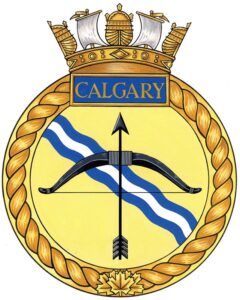
Badge designs are made to connect to the ship’s name, and incorporate heraldic symbology and terminology. For example, colours are described using the heraldic terms gules (red), azure (blue), vert (green), sable (black), purpure (purple), or (gold), and argent (silver or white).
HMCS Calgary’s badge, consisting of a bow and arrow over a wavy background, refers to the region’s Indigenous people and the Bow River, an important local geographical feature. In heraldic language, the badge of HMCS Calgary is described as, ‘Or, a bend wavy azure charged with a like bendlet argent. In front across the centre of a bow stringed fess-wise, and arrow point upwards in pale, both sable’. The term fess refers to the horizontal direction, and pale refers to a vertical direction.
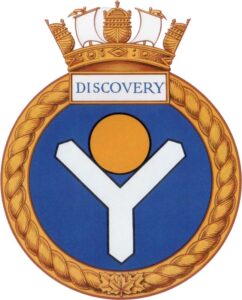
While most badges seek this kind of connection to the ship’s name, some badges contain a rebus, such as a badge for HMCS Discovery that features a yellow ‘disc’ over a white letter ‘y’. Thus, “disc-over-y” = Discovery.
A ship’s badge is a sacred symbol, literally a “badge of honour,” and should be treated with respect. If a ship’s badge is painted on a deck, it is not to be trod upon in normal day-to-day activities.
Most importantly, a ship’s badge should never be referred to as a “crest.” In my day, referring to a ship’s badge as a crest was met with derision or simply mocked with the admonition, “Crest is for teeth. Badges are for ships.” The term “crest” would normally refer to a less formal emblem on a jacket or uniform.
ReadyAyeReady.com has an extensive collection of badge images encompassing nearly all the official badges used by the Royal Canadian Navy since inception.
