

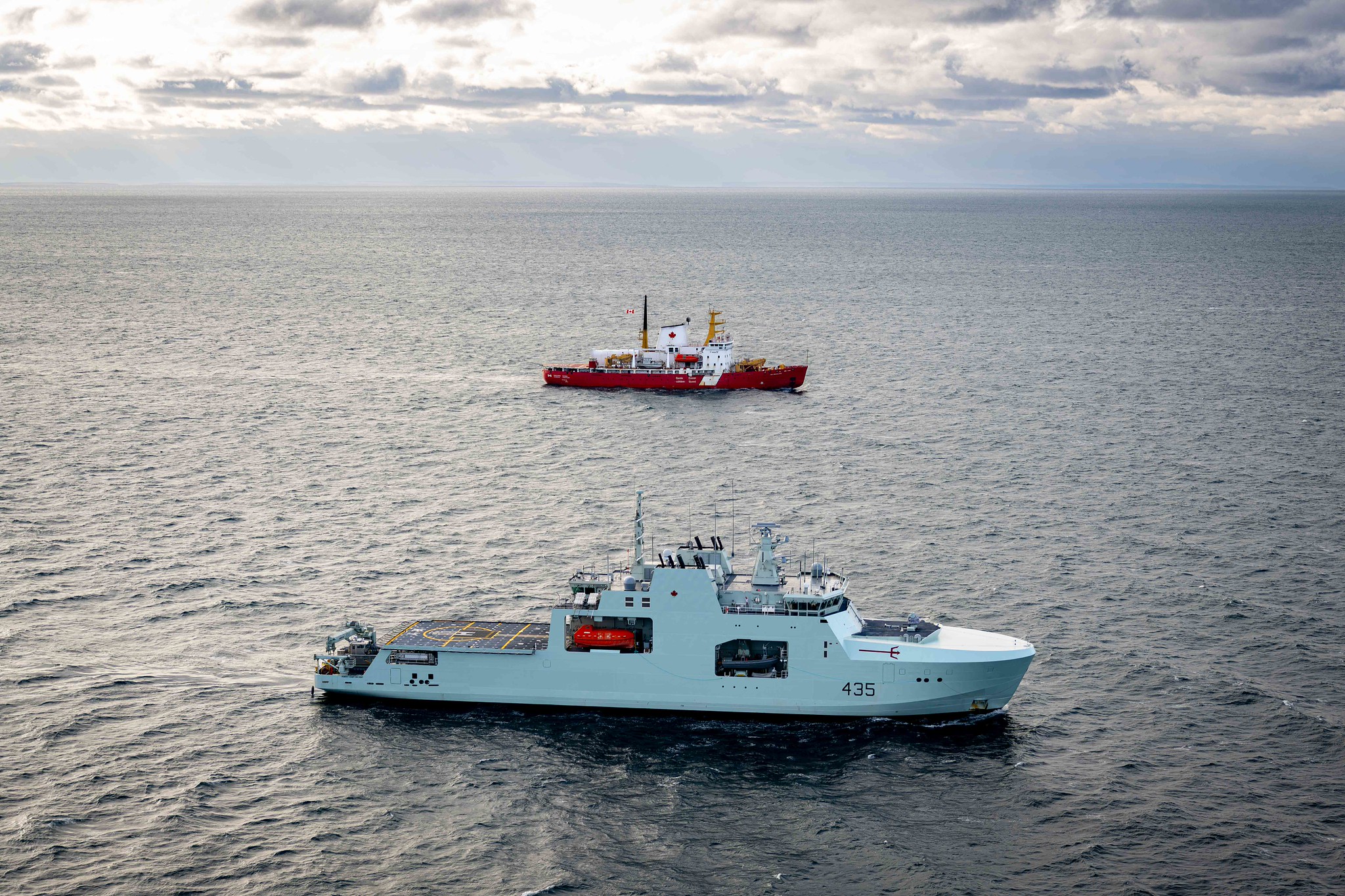
In the waters of Coronation Gulf near Cambridge Bay, Nunavut, the Canadian Coast Guard icebreaker CCGS Des Groseilliers and the Royal Canadian Navy’s newest Arctic and Offshore Patrol Vessel, HMCS Robert Hampton Gray, recently wrapped up a multi-day joint security exercise with the RCMP.
Exercise Arctic Ghost, held from September 15 to 19, 2026, was a Coast Guard-led operation designed to sharpen interoperability among federal agencies in one of the world’s most demanding environments. It focused on sustaining an on-water presence, coordinated surveillance, and the ability to detect and respond to potential security threats in Canada’s Arctic waters.
The timing was notable. HMCS Robert Hampton Gray, delivered to the Navy in August 2025, is on its first operational deployment, which was a rare full westbound transit of the Arctic from Halifax toward its future home port in Esquimalt, British Columbia. The voyage marks only the third complete Arctic transit by a Royal Canadian Navy warship and the first time a Navy vessel has operated with an embarked Canadian Coast Guard helicopter.
The 44-year-old Des Groseilliers, a Pierre Radisson-class icebreaker, has spent decades supporting Northern communities, science, icebreaking and now expanded security tasks after the Coast Guard moved under the Department of National Defence. Its captain, Michel Dufresne, has emphasized that the Arctic is not “uncovered territory.”
About Exercise Arctic Ghost
Partners conducted joint security patrols, simulated searches for suspicious vessels operating without proper identification or authorization in Canadian waters, and practiced the interception of vessels posing a potential security threat. RCMP members were embarked after being picked up in Kugluktuk. The scenarios tested information sharing, whole-of-government coordination, and the ability to operate together in remote Arctic conditions.
These drills echo earlier Arctic Ghost scenarios that have included tracking “dark vessels”—ships running without lights or signals—followed by coordinated interdiction, simulated arrests and casualty evacuation. The 2026 iteration reinforced the same core message: Canada’s presence in the North requires more than any single agency. As one official put it, “If we are going to talk about a presence, you need a whole-of-government approach to presence.”
On the bridge of Robert Hampton Gray near Cambridge Bay, Commander Brian Henwood told CTV News, “This is our territory. These are our Arctic waters.” He added that “the global order is changing, and I think the government is responding to that.”
Broader Arctic Context
The exercise formed part of the wider 2026 Arctic operating season. The Coast Guard deployed multiple icebreakers and support vessels, logging hundreds of cumulative days in the region to support community resupply, aids to navigation, science and security. New Arctic and Offshore Patrol Ships for the Coast Guard itself are also under construction, with the first expected later in 2026.
Climate-driven changes continue to increase maritime access through the Northwest Passage and surrounding waters, raising both commercial interest and security considerations. Exercise Arctic Ghost demonstrated that Canada is pairing its traditional icebreaking and community-support roles with explicit security authorities and closer integration between the Navy, Coast Guard and RCMP.
In the vast, often silent waters of the Canadian Arctic, the red hull of Des Groseilliers and the grey silhouette of Robert Hampton Gray working side-by-side sent a clear signal, and that is about federal agencies who are practicing how to operate as one in a remote region that is growing more strategically important.
