

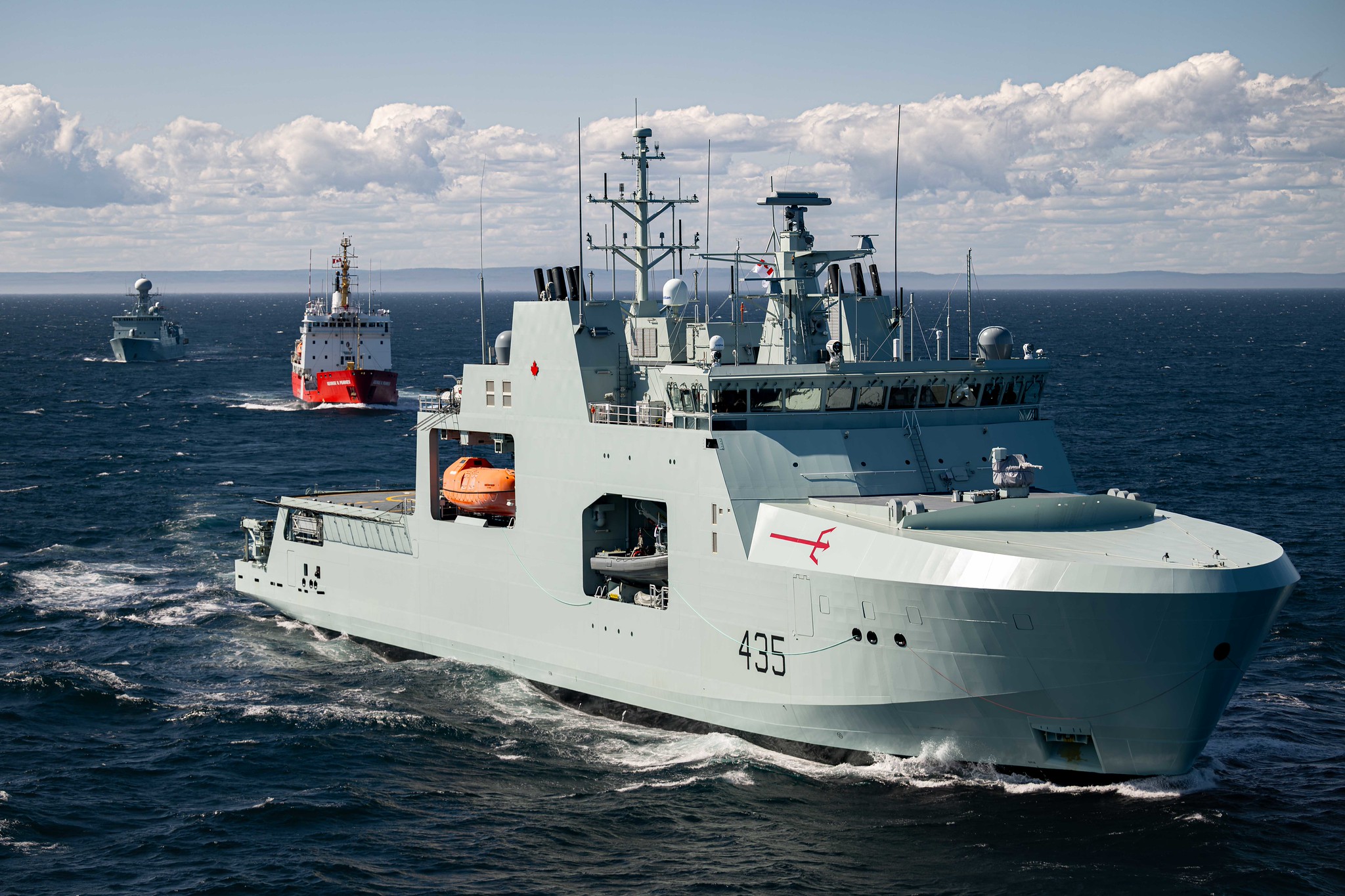
ESQUIMALT, B.C. — A newly built Royal Canadian Navy patrol ship is making one of the rarest journeys in Canadian naval history: a full westbound transit of the Northwest Passage from Halifax to its new home at Canadian Forces Base Esquimalt.
HMCS Robert Hampton Gray, the sixth and final Harry DeWolf-class Arctic and Offshore Patrol Ship, left Halifax earlier this month and is now working its way north toward a port call in Nuuk, Greenland. The ship is expected in Esquimalt in November and is scheduled to be commissioned into the Pacific fleet on Nov. 16.
Navy officials say the voyage is only the third complete Arctic transit by a Canadian warship, after HMCS Labrador in 1954 and HMCS Harry DeWolf in 2021. It is the first such crossing undertaken specifically to move a warship from the Atlantic fleet to the Pacific.
In the future, due to the changing arctic climate, the navy expects such a journey will be more routine.
The 103.6-metre vessel is sailing as part of Operation NANOOK-TUUGAALIK, the maritime serial of Canada’s annual Arctic operation. The Department of National Defence says the ship will work with the Canadian Coast Guard and naval forces from the United States, France and Denmark while conducting patrols, surveillance, community visits and refuelling through the Canadian Arctic Archipelago.
After Greenland, where the crew of about 90 sailors is meeting Danish and American officials, Robert Hampton Gray will transit west through the Northwest Passage and then spend three to four weeks on patrol in the Bering and Chukchi seas before continuing south to Vancouver Island.
“Each year we’re getting less and less ice, so there’s more and more traffic and more interest from other nations up there,” Cmdr. Brian Henwood, the ship’s commanding officer, said in an interview from near Greenland. “Our purpose up there is to keep an eye on what’s going on, be prepared to ensure that Canadian sovereignty, Canadian security is well understood.”
Henwood, who is also task force commander for the operation, said the navy is still building ice experience. The crew will practise manoeuvring around and breaking ice while conducting surveillance and working with the U.S. Coast Guard.
The deployment is also a first for aviation. After the Canadian Coast Guard was transferred from Fisheries and Oceans Canada to the Department of National Defence last year, Robert Hampton Gray is operating with a Coast Guard Bell 429 helicopter on its flight deck — the first time a Canadian navy ship has embarked a Coast Guard helicopter.
The Arctic patrol ships were designed around the larger CH-148 Cyclone maritime helicopter, but integrating that aircraft has required ongoing modifications. Henwood said the smaller Bell 429 is well suited to this mission.
“It gives us that reach to get people ashore, to get cargo ashore, to do some surveillance, medevacs, all that sort of utility work, which is really what an AOPS needs up in the Arctic,” he said.
The ship is named for Lt. Robert Hampton Gray, a British Columbia-born naval aviator and the only member of the Royal Canadian Navy awarded the Victoria Cross in the Second World War. Gray was killed on Aug. 9, 1945, while attacking a Japanese warship in Onagawa Bay. Irving Shipbuilding delivered the vessel to the navy in Halifax on Aug. 21, 2025.
Like the rest of her class, Robert Hampton Gray is built to Polar Class 5 standard, allowing unescorted patrols through first-year ice that earlier navy ships could not reliably enter. The class was designed to give Canada a longer seasonal presence along the Northwest Passage as Arctic waters become more accessible to commercial traffic and foreign research and military vessels.
Lt.-Gen. Steve Boivin, commander of Canadian Joint Operations Command, said the operation is meant to detect activity in Arctic waters, deter challenges to Canadian sovereignty and keep forces ready to defend it. Rear-Adm. Pascal Belhumeur, commander of Maritime Forces Atlantic, said the deployment is also about practising how Canadian sailors work with allies in one of the country’s most demanding maritime environments.
Once Robert Hampton Gray arrives on the West Coast, Esquimalt will be home to two of the six Harry DeWolf-class ships. HMCS Max Bernays was the first of the class assigned to the Pacific fleet. Halifax will remain home port for the other four.
The navy has not released a day-by-day track through the passage. Ice conditions, community visits and allied tasking will determine how quickly the ship moves west. What is already clear is the destination: after months in northern waters, Canada’s newest warship is bound for Esquimalt — arriving not by the Panama Canal, but by the Arctic.
