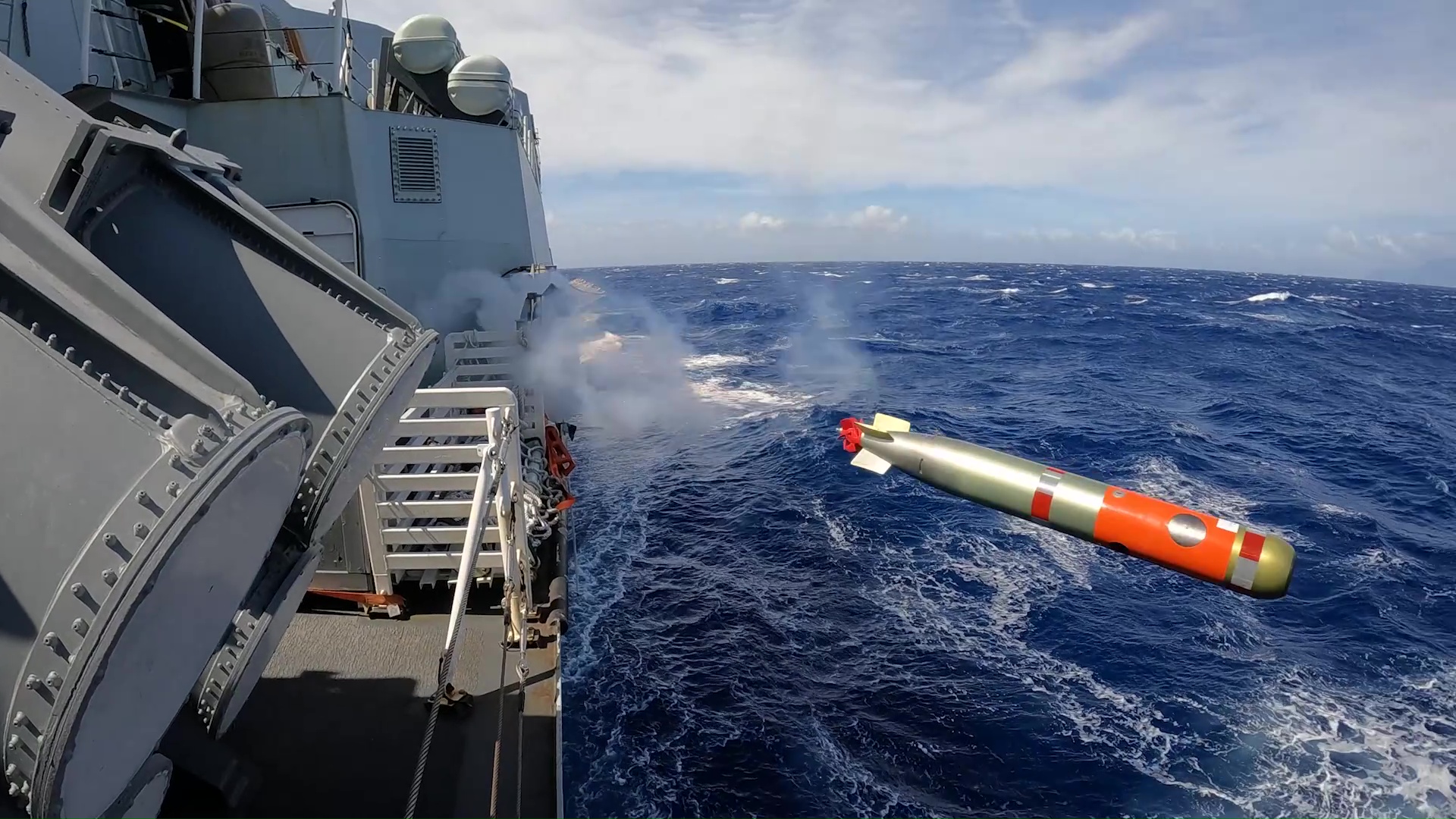
Pacific Ocean off Hawaii – July 2026 – In a landmark demonstration of enhanced anti-submarine warfare (ASW) capabilities, the Royal Canadian Navy Halifax-class frigate HMCS Ottawa (FFH 341) successfully fired a pair of MK 46 lightweight torpedoes during the sea phase of Exercise Rim of the Pacific (RIMPAC) 2026. The live-fire event, conducted in the waters off Hawaii around July 7, 2026, provided the RCN with its first real-world operational opportunity to evaluate the newly integrated Underwater Warfare Suite Upgrade (UWSU).
This milestone underscores Canada’s ongoing modernization of its surface fleet to counter increasingly quiet submarines and advanced underwater threats in both open-ocean and littoral environments.
HMCS Ottawa is the twelfth and final ship of the Halifax-class multi-role frigates, commissioned in 1996 and homeported at CFB Esquimalt on Vancouver Island. As a versatile warship, she is equipped for anti-submarine, anti-surface, and air-defence roles, with a complement of approximately 198 personnel and the ability to embark a CH-148 Cyclone helicopter.
Her primary close-in ASW weapon remains the MK 46 Mod 5 lightweight torpedo, launched from twin Mk 32 Mod 9 torpedo tubes located on either side of the helicopter hangar. These proven torpedoes are highly effective against submarines in shallow to moderate depths.
What is the Underwater Warfare Suite Upgrade (UWSU)?
The UWSU project modernizes the underwater sensor suite across the Halifax-class fleet. Led by General Dynamics Mission Systems–Canada in partnership with Ultra Maritime and other Canadian industry partners, it replaces or upgrades key components to restore and enhance tactical superiority against modern submarines and torpedoes.
Key elements of UWSU include:
- A new towed array sonar with innovative inline low-frequency active projector technology (single-tow design for simplified handling and full-power operation in shallow water).
- Upgrades to the existing hull-mounted sonar for improved wideband performance.
- Enhanced sonobuoy processing system.
- New active intercept sensors, including the Torpedo Sonar Intercept & Classification (TORSIC) system, which detects and classifies incoming enemy torpedoes.
- Improved processing, control, and integration across the suite.
These upgrades enable detection of quieter targets at greater ranges, better performance in complex acoustic environments, and improved ship survivability. The low-frequency active sonar capability is particularly notable, as it significantly extends detection ranges in both deep ocean and near-shore waters.
The project aims for initial deliveries in the mid-2020s, with fleet-wide implementation progressing toward full operational capability later in the decade.
The RIMPAC 2026 Test
RIMPAC 2026, the world’s largest multinational maritime exercise (running June 24–July 31, 2026), brings together forces from over 30 nations, including more than 40 warships, submarines, aircraft, and 25,000+ personnel. Canada contributed HMCS Ottawa, HMCS Regina, a submarine, patrol aircraft, and hundreds of personnel.
During the sea phase, HMCS Ottawa showcased the UWSU by conducting a live torpedo firing exercise. The ship used its upgraded sensors to detect, track, and prosecute a target with a pair of MK 46 torpedoes. This represented the first operational integration and evaluation of the full UWSU suite in a realistic, multinational training environment.
Pre-exercise planning highlighted that RIMPAC would serve as the initial real-world test for the upgraded submarine detection system on HMCS Ottawa.
U.S. Navy and allied documentation captured the event through official b-roll footage of the torpedo firing from HMCS Ottawa during the exercise.
Strategic Importance
Modern submarines are quieter and more capable than ever, and heavyweight torpedoes pose a severe threat to surface ships. The UWSU directly addresses these challenges by giving Halifax-class frigates world-leading Canadian-developed sonar performance, automation to reduce operator workload, and the ability to detect and classify threats earlier and more effectively.
By successfully firing torpedoes while operating the upgraded suite during RIMPAC, HMCS Ottawa demonstrated enhanced readiness for high-intensity ASW operations alongside allies such as the United States, Japan, Australia, and others.
The event also highlights the value of large-scale exercises like RIMPAC for validating new systems in realistic conditions before full fleet deployment.