
HMCS OTTAWA (1st) (H60)
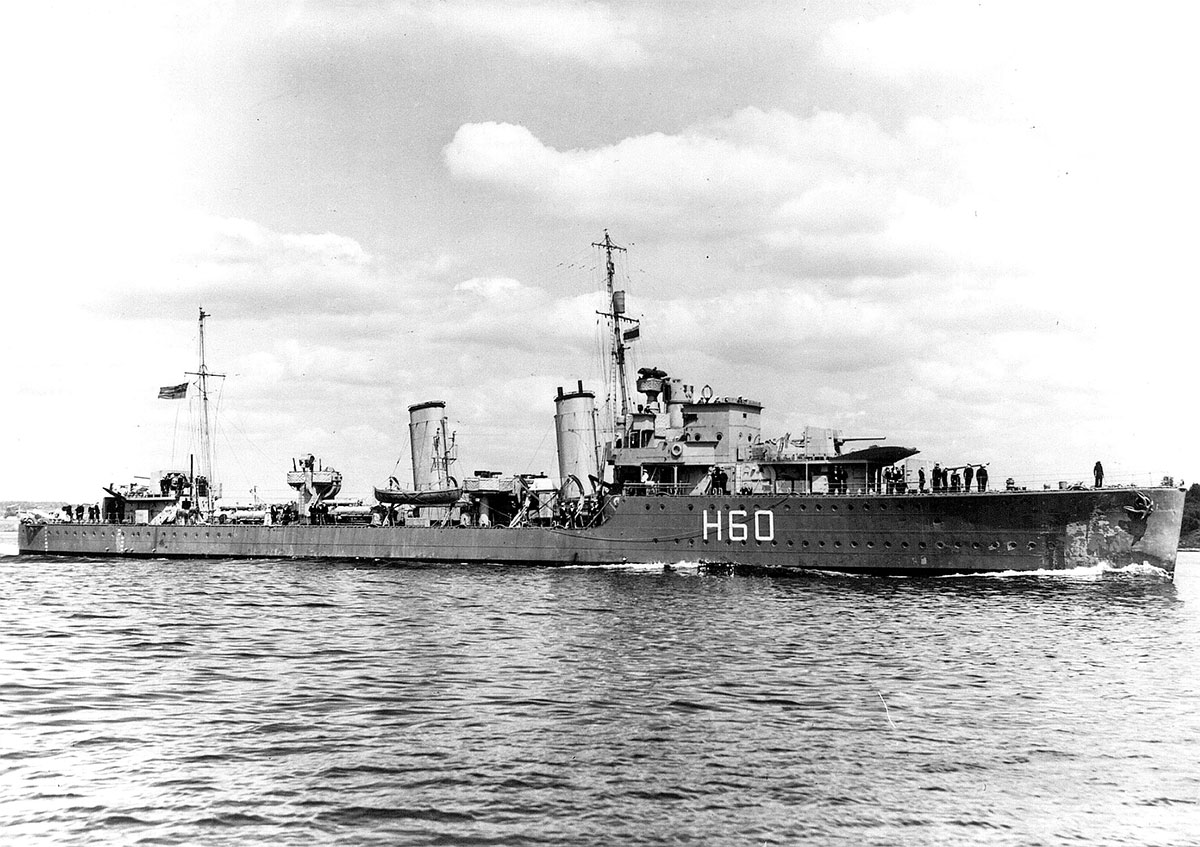
HMCS OTTAWA (1st)
The History of HMCS OTTAWA (1st)
HMCS Ottawa was a destroyer that served in the Royal Canadian Navy from 1938 until she was lost in 1942. Built for the Royal Navy as the C-class destroyer HMS Crusader, she was laid down on 12 September 1930 at Portsmouth Dockyard, launched on 30 September 1931, and completed on 2 May 1932. She served in the Home and Mediterranean Fleets, including duties enforcing the arms embargo during the Spanish Civil War.
In 1938 Canada purchased Crusader and her sister ship Comet as the threat of war grew in Europe. She was commissioned as HMCS Ottawa on 15 June 1938 at Chatham, England, and named for the Ottawa River. In Canadian service she was classified as a River-class destroyer. She displaced about 1,375 tons, measured roughly 329 feet overall, and carried four 4.7-inch guns plus eight 21-inch torpedo tubes. Her designed complement was around 145 men and her top speed was 36 knots.
After commissioning, Ottawa arrived at Esquimalt, British Columbia, on 7 November 1938 for service on the west coast. In May 1939, she acted as senior officer of the Western Destroyer Division and escorted King George VI and Queen Elizabeth during their royal visit to the Pacific coast. When the Second World War began, she was ordered to the Atlantic, departing Esquimalt on 15 November 1939 and reaching Halifax in early December. She then joined escort forces protecting convoys, including the troop convoy that carried half of the 1st Canadian Infantry Division to Britain in December 1939.
During the Battle of the Atlantic, HMCS Ottawa performed extensive convoy escort duties in the North Atlantic, the Caribbean, and the western approaches. In the autumn of 1940 she operated from Scotland with the 10th Escort Group. She rescued survivors from several torpedoed merchant ships, including Sulairia, Eurymedon, and Bussum. On 6 or 7 November 1940 she shared in the sinking of the Italian submarine Comandante Faa di Bruno with the British destroyer HMS Harvester. She later served with the Newfoundland Escort Force and Escort Group C-4 on trans-Atlantic runs.
On the night of 13-14 September 1942, while escorting convoy ON.127 about 500 nautical miles east of St. John's, Newfoundland, Ottawa was attacked by the German submarine U-91. She was hit by two torpedoes, broke in half, and sank. One hundred and fourteen members of her ship's company were lost, including her commanding officer, Acting Lieutenant-Commander Clark Anderson Rutherford. Roughly 69 survivors were rescued by nearby ships. Ottawa also carried survivors from the tanker Empire Oil, some of whom perished in Ottawa's sinking.
HMCS Ottawa received the battle honour Atlantic 1939-45. She was the first of four ships to bear the name in the Royal Canadian Navy. Her loss underscored the heavy cost of the Battle of the Atlantic, while later vessels continued the tradition of service under the name Ottawa.
HMCS OTTAWA (1st) Statistical Data
- Pendant: H60
- Type: Destroyer
- Class: RIVER Class British
- Displacement: 1375 tonnes
- Length: 329 ft
- Width: 33 ft
- Draught: 10.2 ft
- Speed: 31 kts
- Compliment: 10 Officers and 171 Crew
- Arms: 4-4.7", 8-21" Torpedo Tube (2 x IV), 2-2 pdrs. Modified to 2-4.7", 1-3", 4-21" Torpedo Tubes (I x IV), 6-20mm and Hedgehog as war began.
- Builder: Portsmouth Naval Dockyard, Portsmouth, U.K.
- Keel Laid: 12-Sep-30
- Date Launched: 30-Sep-31
- Date Commissioned: 15-Jun-38
- Paid off: 14-Sep-42
Remarks
Ex HMS CRUSADER. Sunk by U91 in the North Atlantic, while escorting convoy ON.127. Lost at about 2330 on 13th September, 1942 due to enemy action being hit by two torpedoes. 114 of her Ship's Company lost.
Photos

HMCS Ottawa (1st)

HMCS Ottawa with a 12-pounder AA gun in lieu of her rear torpedo tubes and 'Y' gun removed. (Wikimedia Commons)

Canadian destroyer HMS Ottawa (H60). (Wikimedia Commons)
Keywords: HMCS OTTAWA (1st), Royal Canadian Navy Ship, Destroyer, RIVER Class British Class